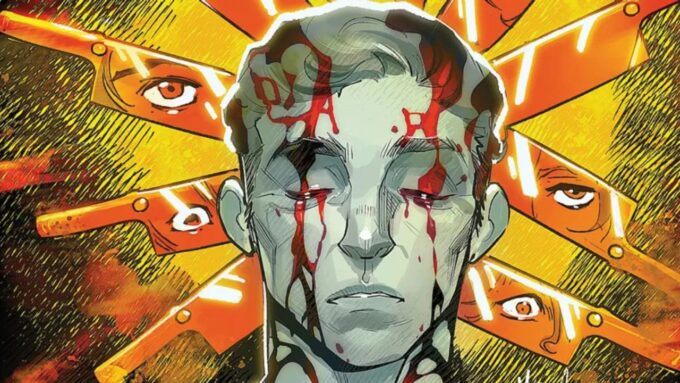

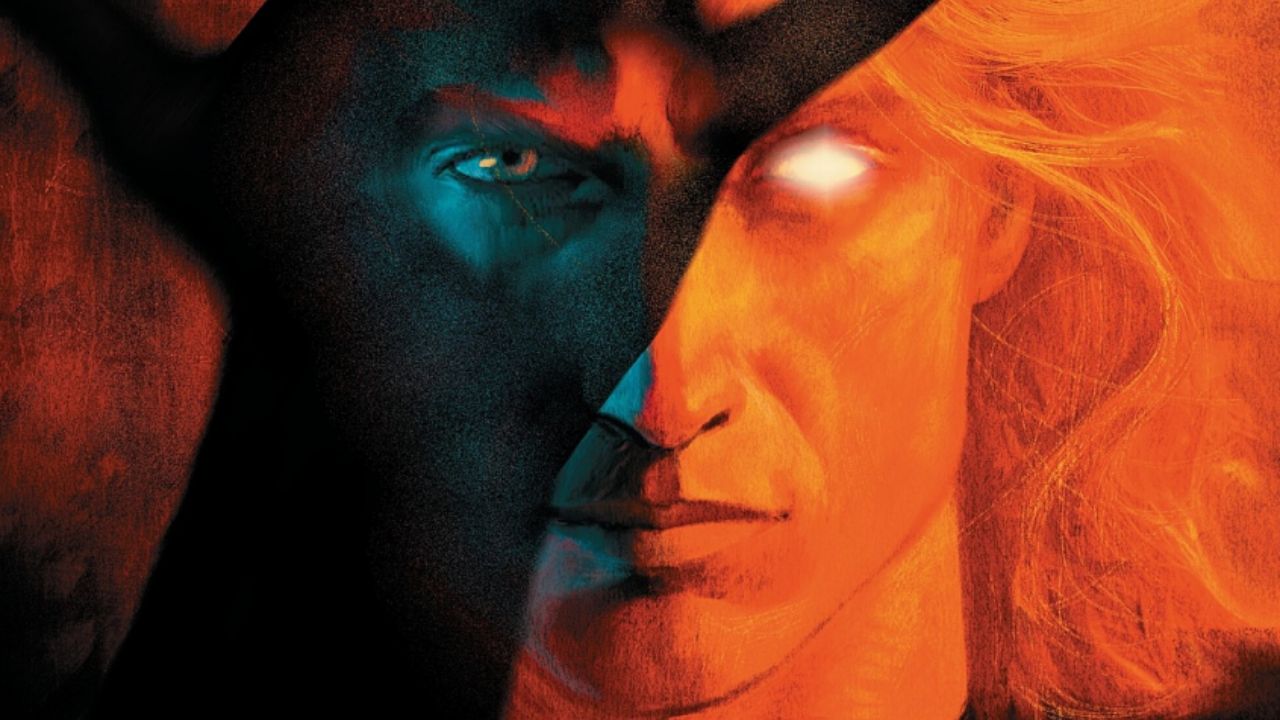
The return of Robert Reynolds to the Marvel Universe is not marked by a triumphant fanfare or a cosmic battle against a new threat. Instead, Sentry #1 (2026) begins with the heavy, rhythmic clicking of a Newton’s cradle and a soul-crushing sense of inevitability. Written by Paul Jenkins—the character’s co-creator—with atmospheric art by Christian Rosado and colors by Matt Milla, this first issue is less of a traditional superhero comic and more of a psychological autopsy of a man who is both a god and a monster. In this detailed breakdown, we’ll explore every page of this haunting debut, from the tragic origins of the Void to the tipping of the scales that threatens to plunge the Marvel Universe into darkness.
The Paradox of Robert Reynolds
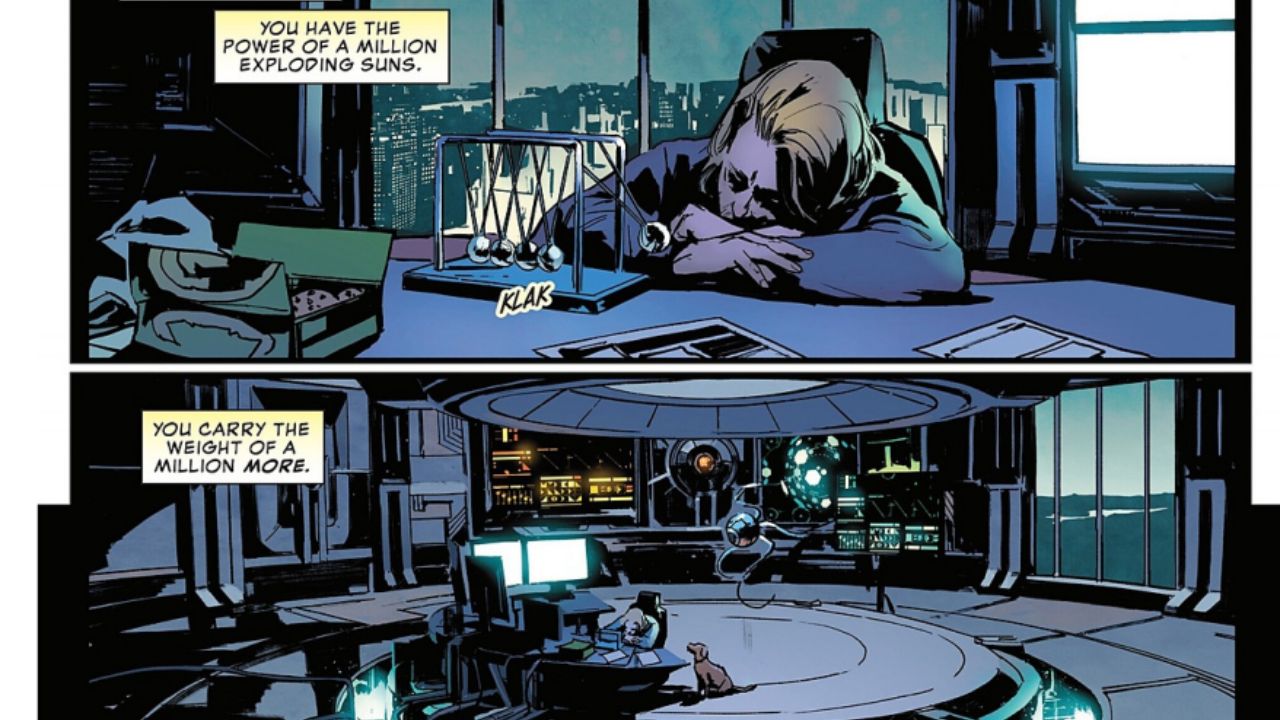
The story opens with a stark, minimalist title page that sets a somber tone . On page 2, we find Robert Reynolds alone in his sanctuary, the Watchtower, overlooking New York City. He is hunched over a desk, a man physically burdened by the weight of his own existence. The narration provides the iconic mission statement for the character: he has the power of a million exploding suns, but he carries the weight of a million more.
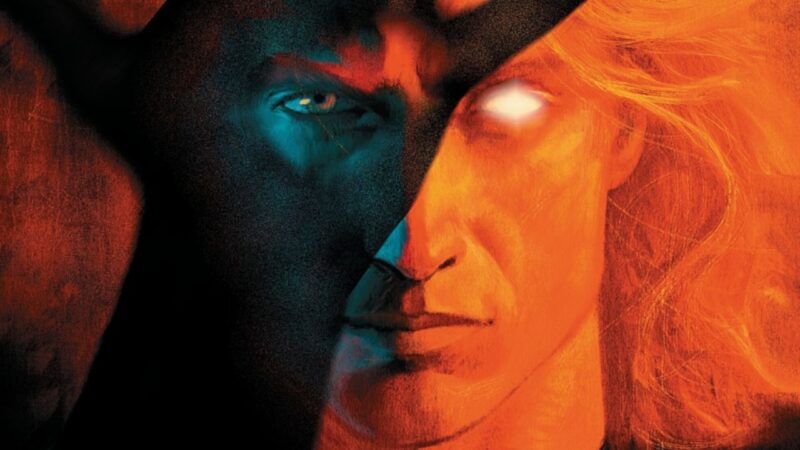
Page 3 provides the essential context for this new series, noting that the events take place before the “Infernal Hulk” storyline. It lists the Sentry’s “nigh-impossible” levels of power—flight, molecular manipulation, energy projection, and superhuman senses. However, it immediately contrasts this divinity with the Sentry’s dark half: The Void. Born from Bob’s subconscious, the Void is a destructive force that seeks to “balance” every heroic act with an equal act of villainy. This page establishes the central conflict of the series—the terrifying reality that for Bob Reynolds to save a life, he may be cosmically obligated to take one.
The Ghost of Laika: Where the Void Began
One of the most poignant sequences in the issue involves Bob’s internal monologue regarding his childhood. He recalls reading the story of Laika, the Soviet space dog who was sent into orbit in a faulty capsule. He describes the horror of her death—how the capsule heated to over 104 degrees just hours after takeoff.
As a seven-year-old, Bob resolved to one day go into space and save her, to “bring her home and love her for the rest of her life”. But he couldn’t, because she was already dead. The narration reveals that this was how the Void first entered his heart—through the realization of absolute, unchangeable loss.
On page 5, we see the Sentry floating through the stars, still searching for a place where he is “unburdened by the gravity of [his] existence” and the “memories of the wicked things” he has done . The art depicts a shadowy, monstrous version of Bob—the Void—reminding him that he didn’t just let the darkness in; he welcomed it . This highlights the deep self-loathing that defines Bob’s psyche.
Shadows in Hell’s Kitchen: A Message for the Kingpin
The narrative shifts abruptly from cosmic contemplation to the gritty reality of Hell’s Kitchen. Wilson Fisk, the Kingpin of Crime, is shown in his typical element, callously ordering the destruction of a man’s life. He orders his home repossessed and, in a moment of extreme cruelty, demands that the man’s cousin—a fish store worker—have her feet removed as compensation.
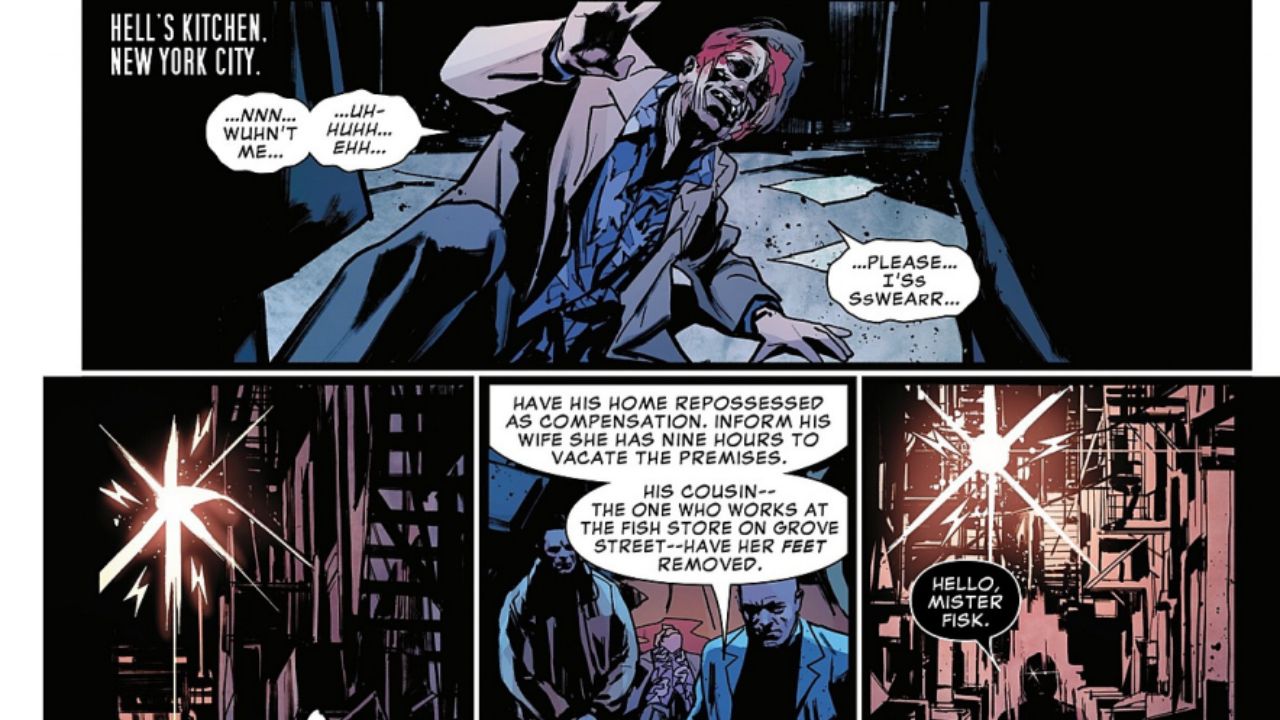
Fisk’s arrogance is cut short when a figure appears. Though it looks like the Sentry, the tone is chillingly different. This entity reveals that he has already neutralized Fisk’s security detail by putting them into a vacuum, turning them into “bodies in space”.
Fisk tries to bribe the intruder, but the response is cold and personal: “I’m going to take everything you hold dear… and I’m going to destroy it. Very slowly. And very, very painfully. Because I hate you” . He claims he is there to deliver a “message of [his] own”. This sequence is vital because it shows the Sentry (or the Void posing as him) acting with a level of malice that suggests the hero’s restraint is rapidly eroding.
The Hero’s Facade and the “Dog and Pony Show”
Bob eventually returns to his wife, Lindy, who has been “worried sick” during his long absence. The internal Void-monologue mocks him, urging him to tell his “best friend” all the terrible things he did while he was away in the “distant reaches of the galaxy”.
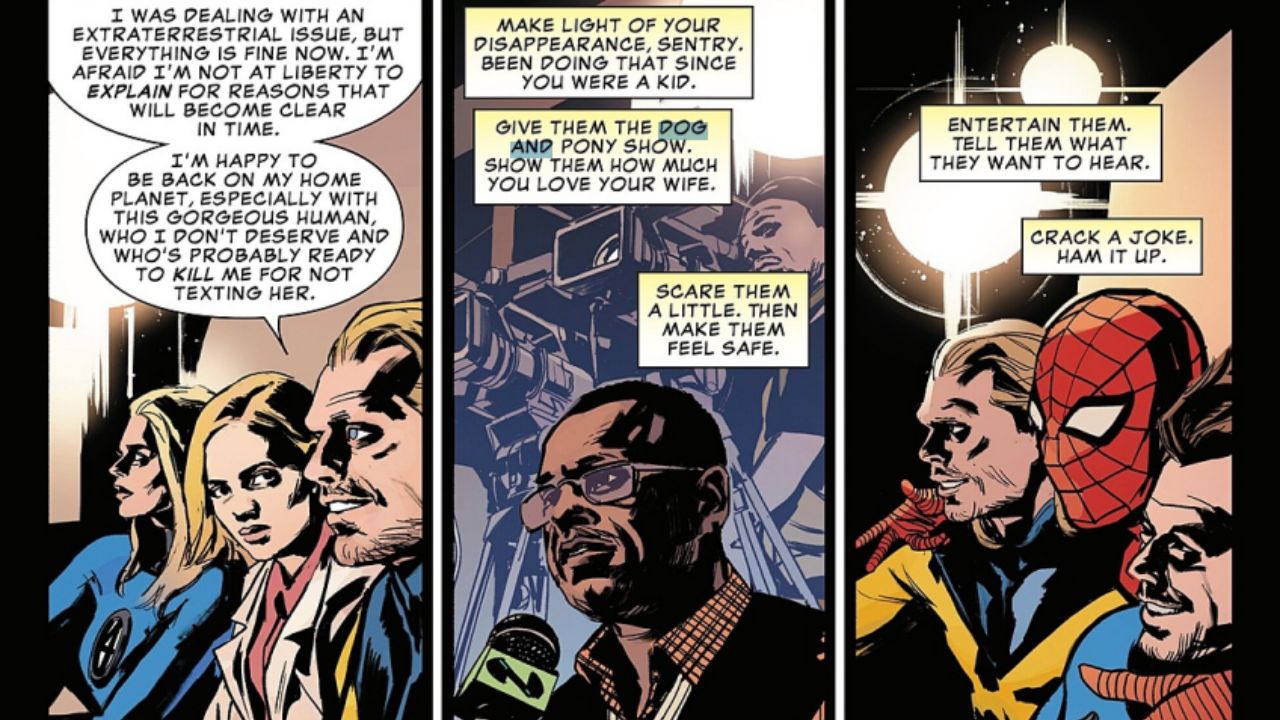
Outside the Watchtower, a media circus is in full swing. Reed Richards, the Avengers, and various reporters are clamoring for a statement . Bob puts on what he calls a “dog and pony show”. He cracks jokes, hams it up for the cameras, and tells the public exactly what they want to hear: that everything is fine and he was just dealing with an “extraterrestrial issue”.
The narrator notes that Bob has been making light of his disappearances since he was a kid to hide the pain. He projects safety and heroism, but the captions tell a different story: he is entertaining them to distract from the reality of who he is becoming.
The Domestic Struggle: Watchdog and Mortality
The facade continues as Bob and Lindy settle back into their domestic life. Lindy asks about the aliens he saw in space, and Bob’s answers are evasive and unsettling: “They’re kinda… like us”. The Void continues to whisper in his ear, telling him to confess his sins as the “creature of the blackest night”.
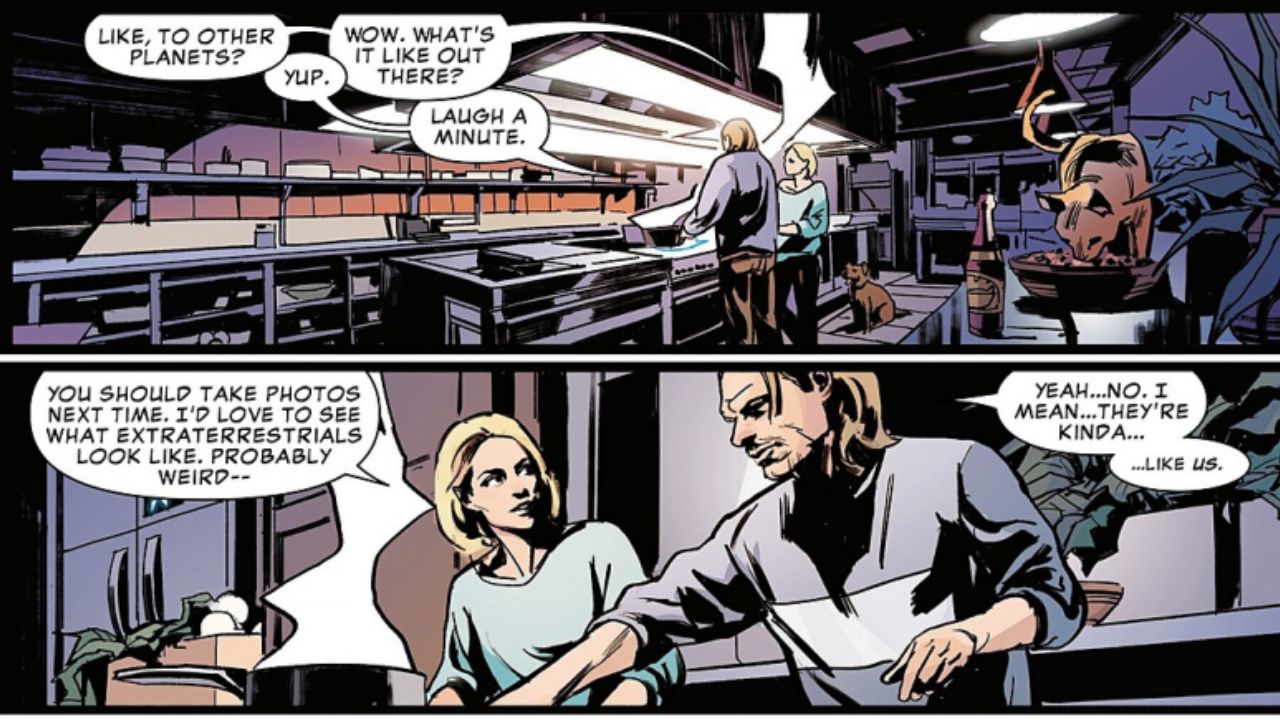
The conversation turns to their dog, Watchdog (Normie). Lindy points out that the dog’s back legs are failing and he’s slowing down. In a moment of desperation, she asks if Bob can use his powers to help him. Bob’s refusal is flat and final: “Lindy, you know I can’t do that”.
He promises her that Watchdog will be okay, but the issue confirms that this is a lie. Just as he couldn’t save Laika, he is powerless to stop the natural aging and decline of his own pet. This parallel reinforces Bob’s greatest fear: that for all his power, he is fundamentally unable to protect the things he loves from the inevitable.
Halcyon Mode and Crystalline Consequences
The action shifts to Paliakua Island in the South Pacific, where a massive, unexplained tsunami is about to hit. The Avengers and Fantastic Four are struggling to contain the wave, but it’s clear they need the Sentry.
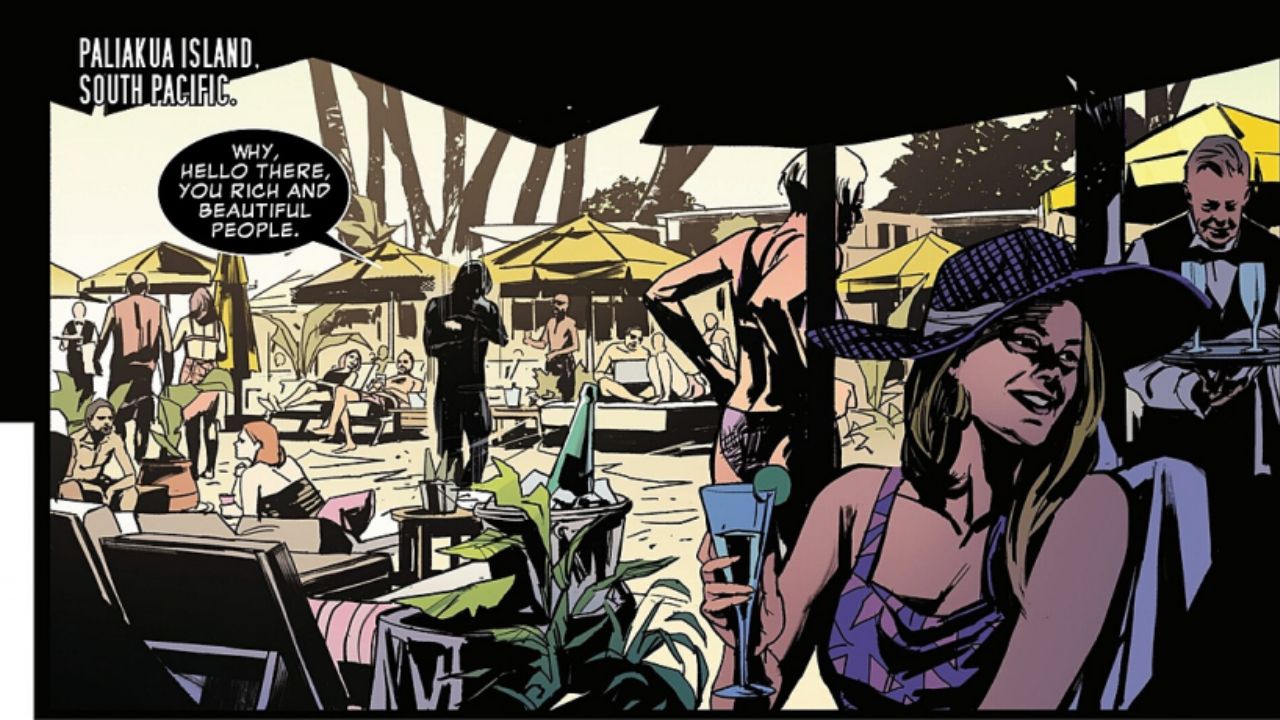
Bob arrives and activates what he calls “Halcyon Mode”. In a massive display of energy, he literally heats the tsunami into a giant cloud of steam, saving the island. While the other heroes are impressed, the aftermath is troubling. News reports on page 20 reveal that while the wave was stopped, an entire village was enveloped by a mysterious “crystalline substance”. Furthermore, a private island belonging to an associate of the Kingpin was submerged with heavy loss of life.
This sequence highlights the “equal and opposite” nature of the Sentry’s existence. He saves an island, but a village is crystalline and lives are lost elsewhere. The “Halcyon Mode” might look like a victory, but the cost is already being extracted.
The Tipping Scales and the Descent
In the final pages, the world begins to fall apart. Unexplained electrical blackouts plague New York, and the Hulk is reported rampaging in Tunguska. Bob is back in the Watchtower, speaking to his AI, C.L.O.C., about the nature of self-deception.
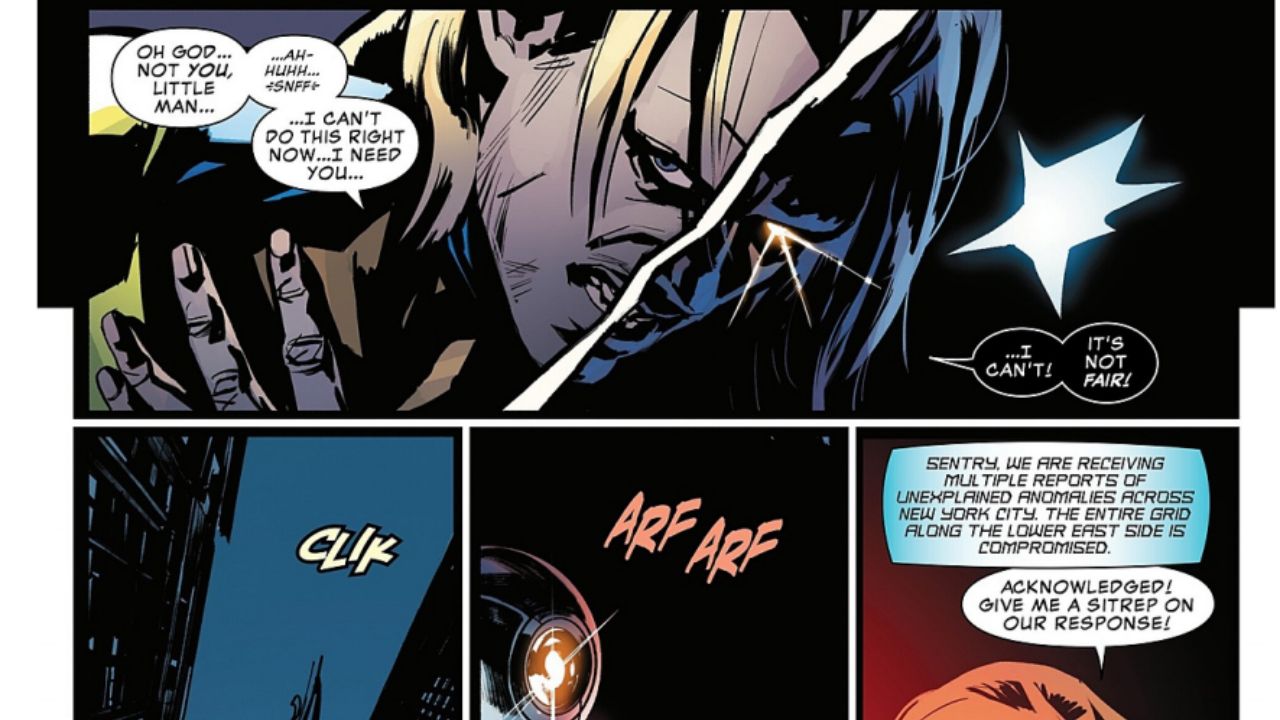
Bob realizes that the “balance” he once relied on is gone. He tells C.L.O.C. that the relationship between him and the Void is no longer equal. “I’ve done some things I’m ashamed of,” he admits. The narrator confirms his fears: Bob has been lying to himself, and the Void has finally tipped the scales.
The issue reaches a fever pitch on page 25. C.L.O.C. reveals that Watchdog is terminal, and the Avengers are calling for immediate assistance as “crystalline growth” consumes New York’s power grid . Captain America, Iron Man, and Spider-Man are all pleading for the Sentry to respond, reporting that the Hulk has been found in a “bad way”.
But Bob is paralyzed. He sits in the dark, watching the screens of a world he can no longer “save” without making things worse. The Void’s voice gets the final word, mocking him: “Admit it, Sentry: You can’t even save yourself”.
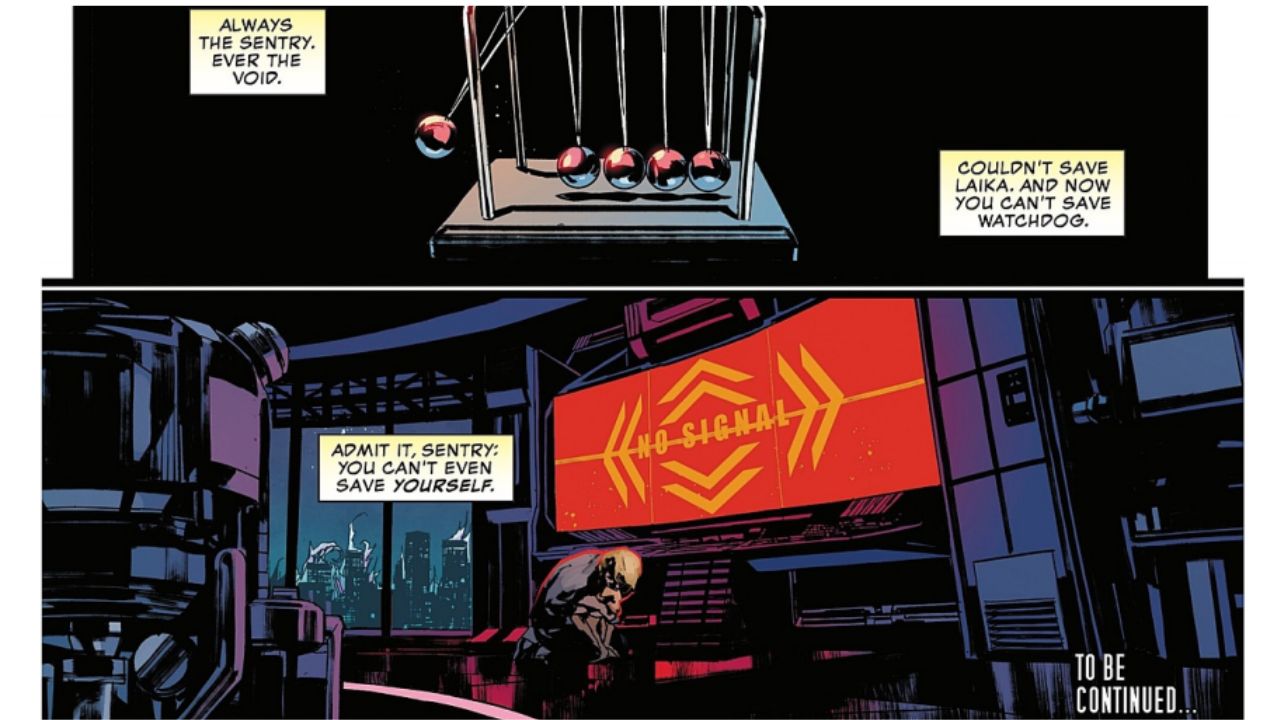
The story ends on a cliffhanger, leaving Bob Reynolds at his lowest point as the “To Be Continued” banner appears.