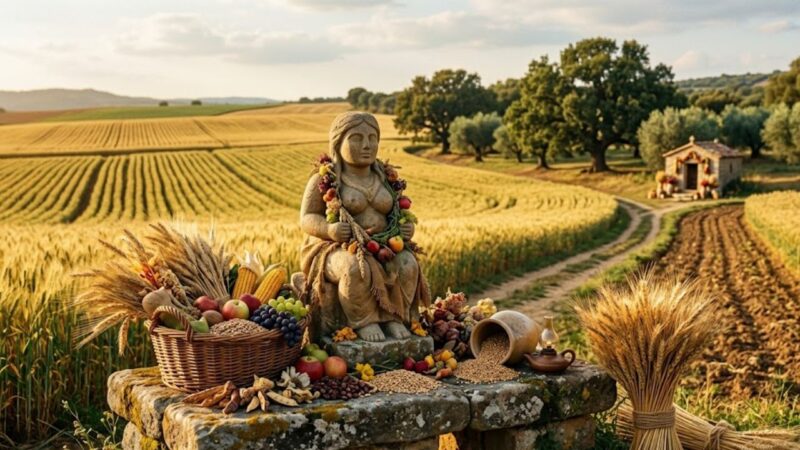

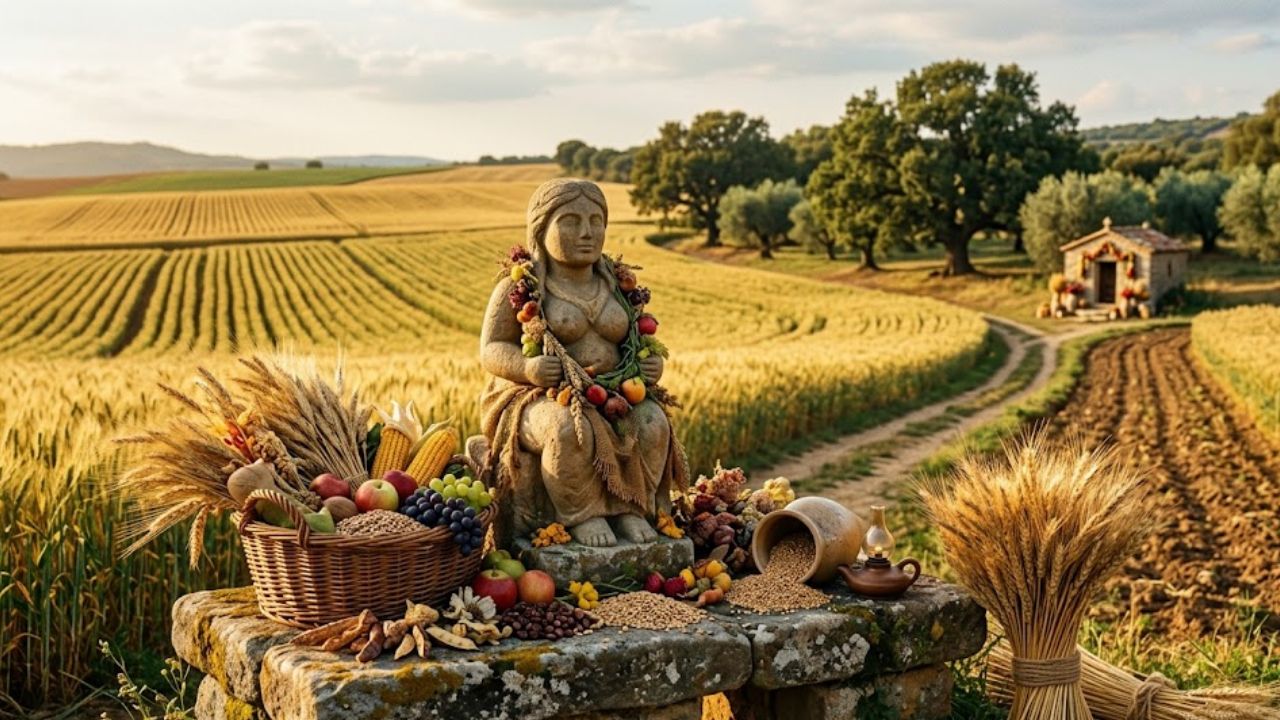
Before the clock, there was the seed. Before the calendar, there was the harvest. And before theology, there was hunger. Across thousands of years and dozens of civilisations, human beings looked at the same mystery — why does the earth die and return? — and arrived, independently, at a strikingly similar answer: a goddess made it so. The worship of fertility goddesses is not a footnote in religious history. It is arguably the oldest and most widespread spiritual impulse humanity has ever known. From the figurines of Çatalhöyük to the temples of Isis, from the rice-planting rites of Southeast Asia to the corn-mother dances of the American Southwest, the feminine divine and the agricultural calendar were bound together in an embrace that shaped law, art, empire, and the human imagination. At the heart of this enduring belief lies a simple truth: Agricultural Cycles Shaped the Worship of Fertility Goddesses, turning the rhythms of planting and harvest into sacred narratives of life, death, and rebirth. This is the story of how the turning of the seasons created the gods — and what it means that they were so often women.
The First Farmers and the First Gods
When the Neolithic revolution transformed human societies from nomadic hunter-gatherers into settled agricultural communities — beginning around 10,000 BCE in the Fertile Crescent and spreading outward over millennia — it did more than change what people ate. It changed how they understood time, causality, and the sacred.
For a hunter, the world is unpredictable. Animals move. Herds vanish. The divine, in such a world, tends to be dynamic, capricious, present in the storm and the chase. But for a farmer, the world is cyclical. Plant in spring, harvest in autumn, starve or survive in winter, begin again. This rhythm — reliable yet terrifyingly fragile — demanded an explanation.
The earth itself provided the metaphor. Seeds planted in darkness germinate into light. A field, once cut down to bare stubble, regrows. The land receives, gestates, and delivers. It is, in every observable sense, maternal. And so the earliest agricultural peoples began to project onto it the attributes of motherhood: creativity, abundance, the fearsome power of birth and death.
The result was an explosion of goddess worship timed precisely to the agricultural calendar.
Demeter and the Greek Agricultural Year
Perhaps no mythology maps the farming cycle onto the divine feminine more explicitly than the Greek myth of Demeter and Persephone — a story so ancient that scholars believe its core elements predate classical Greek civilisation by centuries, possibly originating in pre-Hellenic agricultural cults of the Bronze Age Aegean.
Demeter, goddess of the grain, has a daughter: Persephone. When Hades abducts Persephone to the underworld, Demeter’s grief is so absolute that she withdraws her gifts from the earth. The crops fail. The soil hardens. Humanity faces extinction. Eventually, a compromise is struck: Persephone will spend part of the year below ground and part above.
The result is the seasons themselves.
What makes this myth remarkable is its transparency as agricultural allegory. Persephone’s descent is the seed going into the earth. Her time in the underworld is winter — the period of dormancy, of waiting, of anxious uncertainty about whether the world will renew itself. Her return is spring, the moment the grain pushes upward again, the moment Demeter smiles and the meadows flower.
The Eleusinian Mysteries, the most important religious rites in the ancient Greek world, were organised entirely around this myth and held twice yearly in accordance with the agricultural calendar. Initiates travelled from across the Mediterranean to participate in secret ceremonies that scholars believe dramatised the descent and return of Persephone — and by extension, the death and rebirth of the grain. For over a thousand years, from approximately 1500 BCE to 392 CE, these rites shaped Greek — and later Roman — spiritual life. They were, at their heart, a liturgy of the harvest.
Isis and the Flooding of the Nile
Egypt presents a variant of the same phenomenon, shaped by a different but equally agricultural concern: not rainfall and seasonal temperature, but the annual inundation of the Nile.
Egyptian civilisation was wholly dependent on the Nile flood. Each year, the river rose, deposited its rich black silt across the delta and floodplain, and receded — leaving behind the extraordinarily fertile soil that made Egypt the breadbasket of the ancient world. The timing and extent of this flood determined whether Egypt ate or starved.
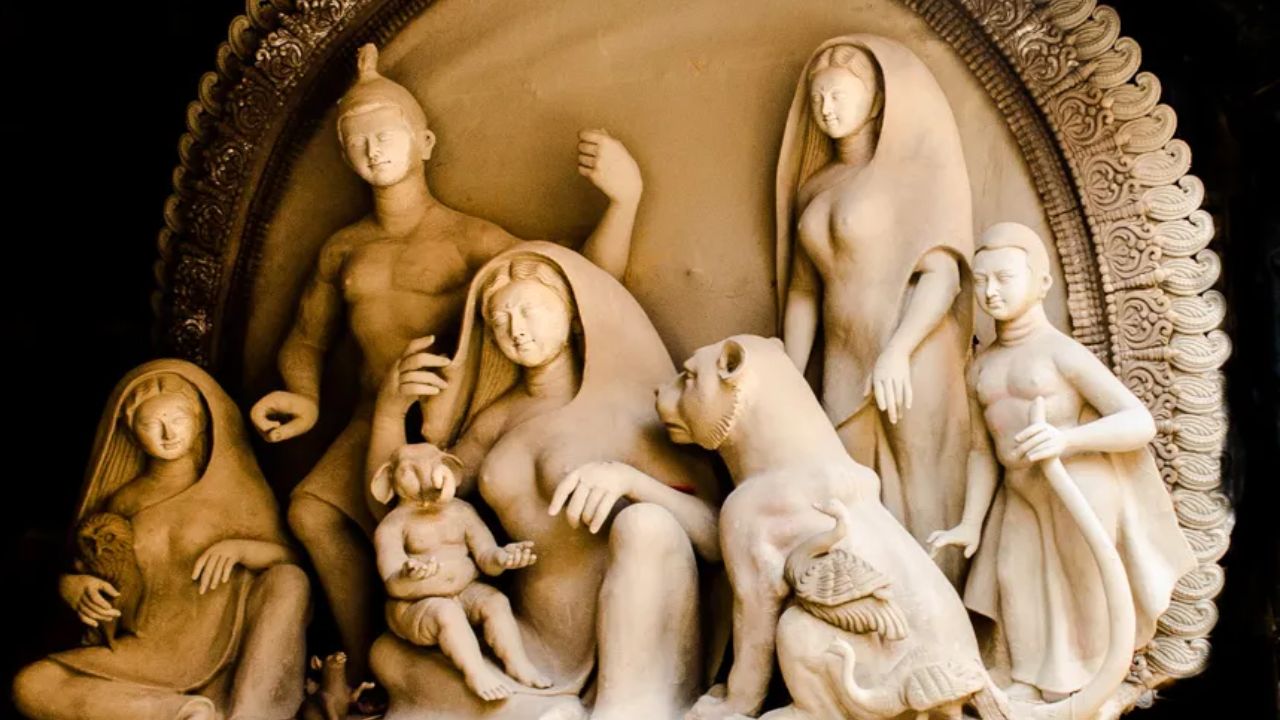
Into this context came Isis, whose mythology became one of the most elaborate fertility narratives in human history. Her husband Osiris is murdered by his brother Set and his body scattered across Egypt. Isis, in her grief and love, travels the land gathering his pieces, reassembles him, and through her magical power conceives their son Horus. Osiris descends to rule the underworld; Horus inherits the earth.
The agricultural resonance is unmistakable. Osiris was explicitly associated with grain — he was sometimes depicted with green skin, the colour of growing things — and his dismemberment and reassembly mapped onto the agricultural act of cutting, scattering, and harvesting seed. Isis, in gathering and restoring him, became the force that renewed the land’s fertility.
Her cult was timed to the Nile calendar. The star Sirius — whose heliacal rising the Egyptians called the “going up of Sothis” — appeared in the Egyptian sky just before the Nile began to flood. This rising became associated with Isis’s tears of grief for Osiris, and her weeping was understood to cause the inundation that fertilised the land. The goddess’s sorrow was the earth’s salvation.
The Isis cult eventually spread throughout the Roman world, becoming one of the most significant mystery religions of late antiquity — exported far beyond Egypt’s floods, but carrying within it the indelible imprint of an agricultural cosmology.
Inanna, Ishtar, and the Mesopotamian Descent Narrative
Mesopotamia — the civilisation that arose between the Tigris and Euphrates, probably the world’s oldest urban culture — developed its own fertility goddess mythology in the form of Inanna (Sumerian) and her later Akkadian equivalent Ishtar.
The “Descent of Inanna,” one of the oldest literary texts in human history (dating to approximately 1900–1600 BCE but almost certainly reflecting oral traditions far older), tells of Inanna’s journey into the underworld, her death at the hands of her sister Ereshkigal, and her eventual resurrection and return. Her consort Dumuzi — a shepherd-king associated with agricultural abundance — is made to take her place in the underworld for half the year.
The seasonal correspondence is direct. During Dumuzi’s time below, the land suffers. Livestock do not mate. Plants do not fruit. The great lamentation over Dumuzi — performed by Mesopotamian women as a ritual mourning ceremony — was a liturgical response to the dying of the summer vegetation. His return each spring was cause for celebration: the return of fertility, of abundance, of the agricultural year’s renewal.
What is particularly striking in the Mesopotamian case is the institutional weight of this worship. Inanna/Ishtar was not a minor cult goddess but one of the most powerful deities in the Mesopotamian pantheon. The city of Uruk, one of the world’s first cities, was her city. Her temples were economic institutions — storing grain, managing redistributive networks, employing thousands of workers. The goddess of fertility was, in a very literal sense, the administrator of agricultural surplus.
Lakshmi, the Rice Goddess, and the South and Southeast Asian Traditions
The Hindu tradition offers a different but equally agricultural understanding of feminine divinity. Lakshmi — goddess of prosperity, abundance, and fortune — has ancient roots in Vedic goddesses of agricultural wealth, and her worship has been tied to harvest festivals for millennia.
Diwali, the festival of lights celebrated across South Asia in autumn, has complex and layered meanings, but one of its most ancient substrata is an agricultural festival marking the end of the harvest season and the beginning of a new accounting year. Lakshmi’s blessing is sought at this moment — the moment when the year’s agricultural labour converts into stored grain and wealth, when the question of whether a household will prosper or suffer through the coming months is determined.
In Southeast Asia, the connection between fertility goddesses and agricultural cycles is even more explicit. Across Indonesia, the Philippines, Thailand, and Vietnam, rice — the foundational crop of Asian civilisation — has been personalised as a goddess spirit. In Indonesia, Dewi Sri is the goddess of rice and fertility. Her mythology, which includes themes of death, burial, and miraculous growth from her body, maps with striking clarity onto the agricultural reality of the rice cycle: the seed pressed into the paddy, the long weeks of anxious watching, the eventual harvest.
Rituals surrounding Dewi Sri were calibrated to the precise stages of the agricultural calendar. Planting ceremonies invoked her protection. Harvest ceremonies thanked her. The colour, smell, and quality of the rice were read as signs of her pleasure or displeasure. She was not a distant metaphysical principle but an intimate presence in the fields — one whose moods directly determined whether a family ate.
The Corn Mother in the Americas
When European explorers arrived in the Americas, they encountered agricultural civilisations that had, without any contact with Old World religious traditions, independently developed goddess-centred agricultural mythologies of remarkable sophistication.
Among the Pueblo peoples of the American Southwest, the “Corn Mother” or “Corn Maiden” was a central spiritual figure. Corn — maize — was not merely a food crop but a sacred substance, understood as a gift from the divine feminine and treated with corresponding reverence. Corn pollen was used in prayer and ceremony. Corn fetishes were created and venerated. The agricultural calendar of planting, growth, harvest, and storage was accompanied by a dense cycle of ceremonies, many of which dramatised the disappearance and return of the Corn Maiden.
The Cherokee told of Selu, the Corn Woman, whose body gave rise to the first corn plants. The Iroquois spoke of the “Three Sisters” — corn, beans, and squash — as three divine women whose cooperation sustained human life. In each case, the agricultural staple was feminised and sacralised, its cycle understood as a story of divine generosity requiring human reciprocity in the form of ceremony, respect, and proper agricultural practice.
Among the Maya and Aztec civilisations to the south, the connection between feminine divinity, agricultural cycles, and institutional religion was even more elaborate. The Aztec goddess Chicomecoatl — “Seven Serpent” — was the goddess of maize and sustenance. Her festivals fell precisely at the points in the agricultural calendar when human intervention in the crop’s fate was most intense: planting and harvest. She was depicted holding ears of corn, symbolically offering them to the human world.
Why Goddesses? The Deep Logic of the Feminine Divine
The convergence of so many independent traditions on a feminine agricultural deity invites a question: why female?
Part of the answer is obvious but worth stating plainly. Agricultural fertility and biological fertility share the same mechanism, at least as it appeared to pre-scientific observation. Seeds go into the earth and, after a period of darkness and waiting, new life emerges. This mirrors, with uncanny precision, the experience of pregnancy. The earth receives, gestates, and delivers, exactly as a woman does. The metaphor was not invented; it was observed.
But the identification runs deeper than metaphor. In many of these traditions, the goddess is not simply like the earth — she is the earth, or a manifestation of its generative power. Demeter’s grief does not represent winter; it causes it. Inanna’s absence is the dying of the crops. These are not allegories but cosmologies: accounts of how the world actually works, in which the divine feminine is the operating principle of biological renewal.
This has significant implications. In societies where the goddess’s favour literally determines survival, women who are associated with that power — priestesses, ritual specialists, the women who perform the mourning rites for Dumuzi or the planting ceremonies for Dewi Sri — hold genuine social authority. The worship of fertility goddesses was not always merely sentimental. In many cases, it was the operating ideology of a society organised around agricultural production, and those who mediated between the community and the goddess held real power.
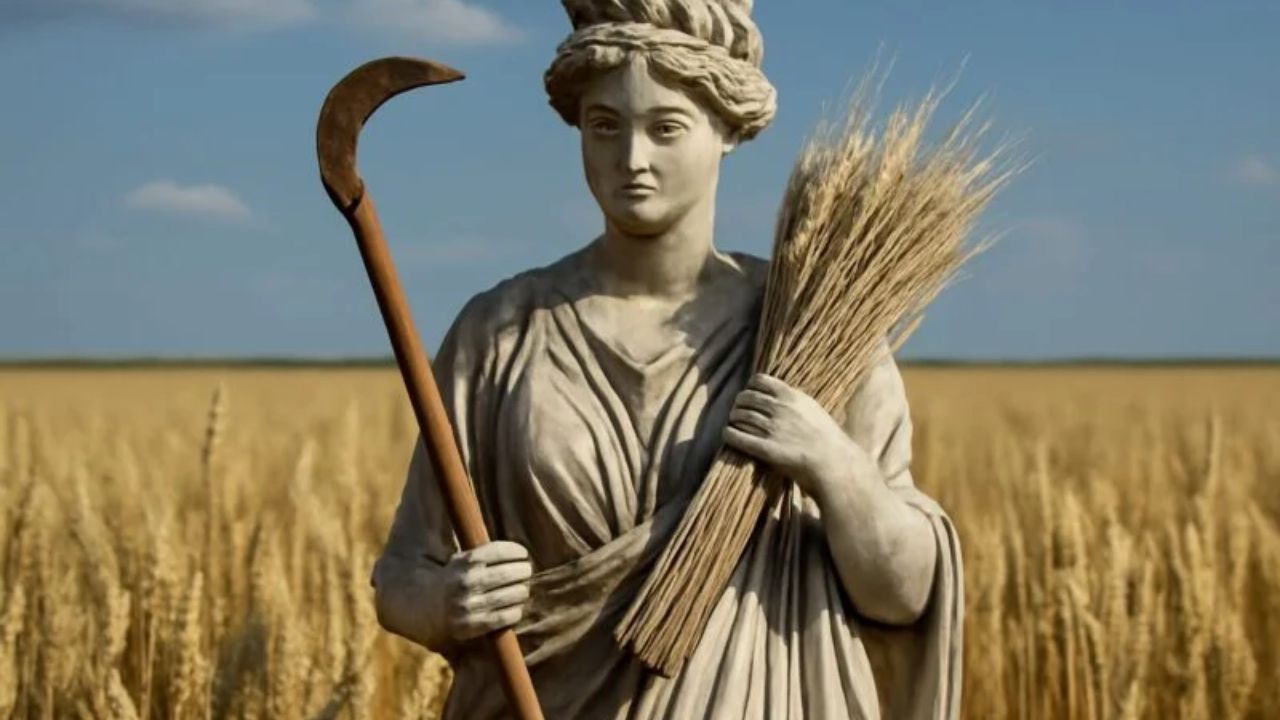
The Decline and Transformation of Agricultural Goddess Worship
The great agricultural goddess cults did not disappear suddenly. They eroded, transformed, were absorbed, and in many cases survive in only partially recognised forms.
The Christianisation of Europe replaced Demeter and Isis with the Virgin Mary — a transformation that has attracted enormous scholarly attention precisely because it is so incomplete. Mary, like the goddesses she implicitly displaced, is associated with abundance, with harvest imagery, with the month of May (historically a planting festival month), and with the protection of agricultural communities. Her feast days cluster suspiciously near the old pagan agricultural calendar dates. Whatever the theological differences, the affective and ritual needs she met were, for many ordinary people, continuous with those previously met by the earth goddesses.
In India, the continuity is even more visible. Lakshmi did not replace an older goddess; she was the older goddess, or rather a persistent thread in a continuous tradition that stretches back to the Indus Valley Civilisation and its as-yet-undeciphered imagery of female figures associated with vegetation and animals.
In Japan, Inari — a deity of foxes, rice, and fertility — has been worshipped continuously since at least the 8th century CE and has more shrines dedicated to them than any other kami in Shinto. Inari is androgynous or plural in conception but frequently depicted in female form, and their connection to rice — Japan’s foundational crop — remains central. Today, Inari shrines are among the most visited religious sites in Japan, and offerings of rice, sake (rice wine), and fried tofu are still left at them.
What the Goddesses Knew
There is something both humbling and clarifying about recognising how thoroughly the great intellectual and spiritual architectures of ancient civilisation were built on a very practical foundation: the need to eat.
The fertility goddesses were not primitive superstitions awaiting correction by more sophisticated religion. They were attempts — sophisticated, elaborate, institutionally powerful attempts — to make sense of humanity’s most urgent dependency: the capacity of the living earth to sustain human life.
That the earth is not, in fact, controlled by a goddess named Demeter or Isis or Inanna does not diminish the insight encoded in their myths. The insight is this: the processes that sustain human life are cyclical, not linear; they involve death as a precondition for renewal; they demand attention, care, and what we might now call ecological reciprocity; and they are, in the final analysis, not fully under human control.
The agricultural goddess, in her descent and return, in her grief and her abundance, in her terrifying power to withhold as well as to give, encoded a truth that modern industrial agriculture has been at great pains to forget: that food does not come from supply chains. It comes from the earth. And the earth, on its own terms, is not interested in our schedules.