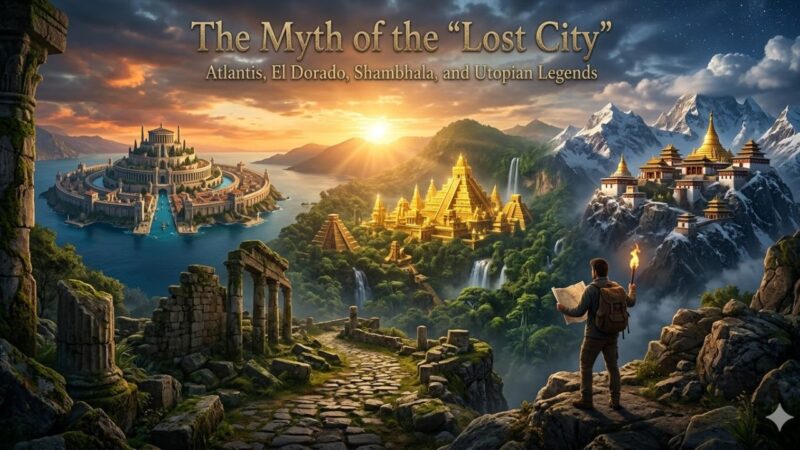

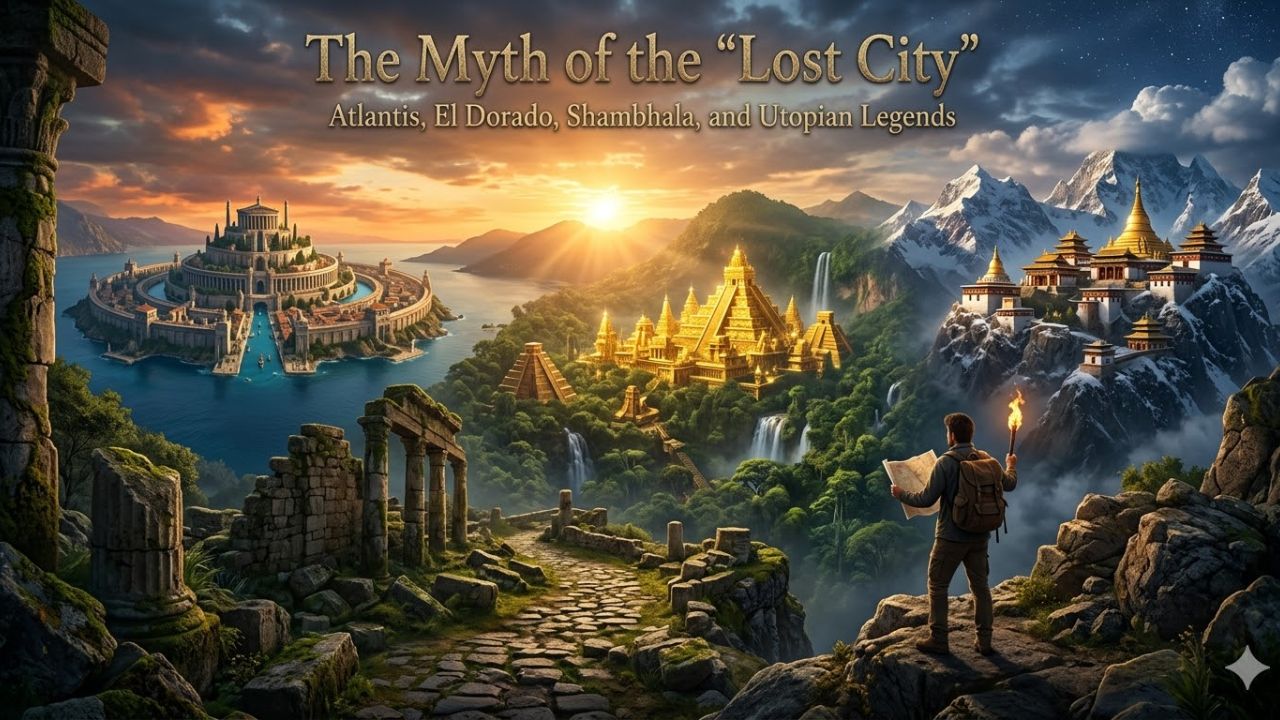
Across cultures and centuries, people have been captivated by stories of places that may never have existed—cities where the streets gleam with gold, kingdoms swallowed by the sea, or hidden valleys where wisdom and peace endure beyond the reach of ordinary time. These tales are more than idle fantasies. The Myth of the Lost City has long served as a powerful cultural symbol where archaeology, geology, religion, politics, and psychology converge. Legends such as Atlantis, El Dorado, and Shambhala, often grouped among the world’s great Utopian Legends, reveal how societies imagine perfection, loss, and discovery. By weaving together classical accounts, historical traditions, and modern scientific insights, these narratives show that lost-city myths may sometimes echo real events—but more often they act as mirrors reflecting humanity’s deepest hopes, fears, and enduring search for an ideal world.
Why the Lost City Matters
At first glance the lost-city genre looks like a bundle of entertainments—adventure tales, treasure maps, the thrill of discovery. A closer look reveals a grammar of meaning. Lost cities do four things for their cultures:
• They offer utopian critique: by imagining a better place, a narrative can illuminate the defects of the present.
• They mediate catastrophic memory: sudden geological events that reshape landscapes get encoded as moral parables.
• They fuel exploration and exploitation: legends like El Dorado launched real expeditions with real consequences.
• They act as psychic symbols: places like Shambhala double as maps of inner transformation.
This is why we still care. The myth is not only about a place on a map; it’s a place in the mind.
Atlantis: Plato’s Parable, Earth’s Echo
When we speak of “Atlantis” we are speaking first of Plato’s allegory. In Timaeus and Critias Plato frames Atlantis as a large island nation “beyond the Pillars of Hercules,” technologically advanced and morally compromised—an empire punished by the gods for its hubris. Plato’s apparent aim was pedagogical: to contrast an ideal polity with the perils of imperial hubris.
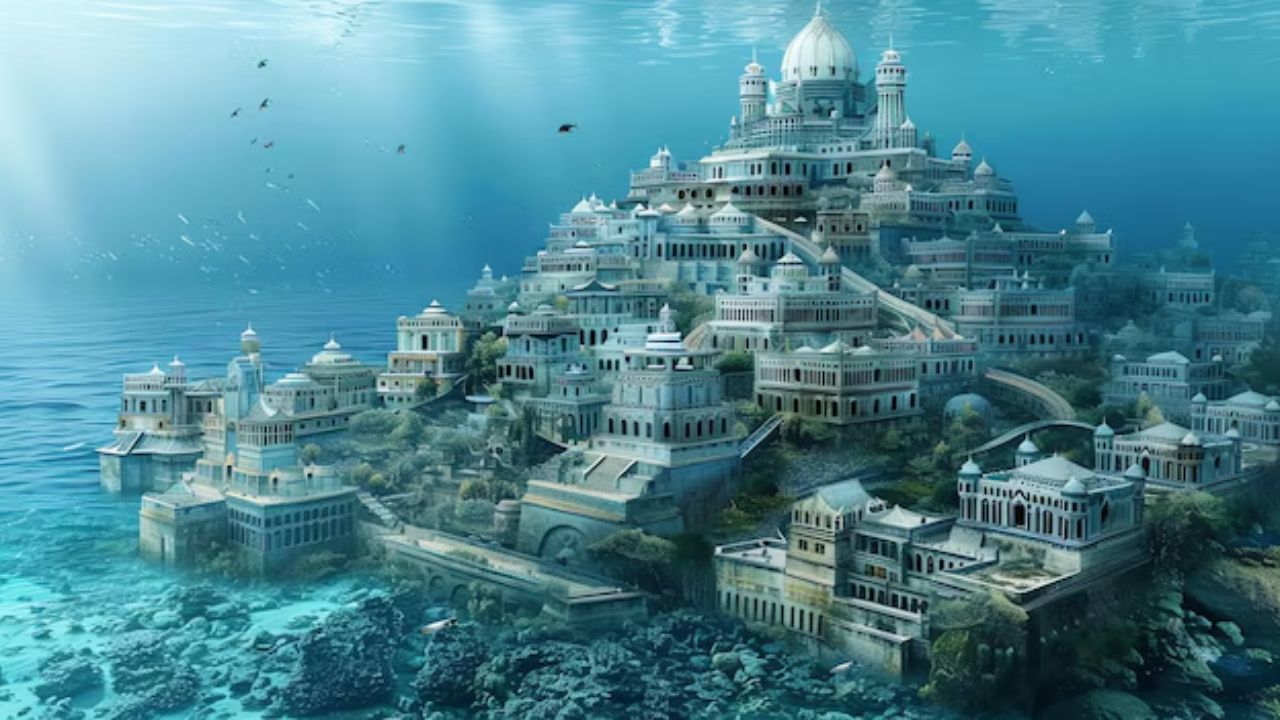
That didn’t stop later centuries from treating the story as a geographical puzzle. The persistence of the Atlantis myth owes much to the human habit of literalizing metaphors. Yet beneath the philosophical layer lies another reality: the Mediterranean has a modern example of a once-splendid island abruptly transformed by eruption—the Thera (Santorini) catastrophe. The Minoan eruption was enormous: a Plinian event that sent ash into the stratosphere, generated tsunamis and helped destabilize Bronze Age maritime networks. The archaeological site of Akrotiri reveals a sophisticated, palace-centered life, suddenly interrupted—evacuation rather than mass burial being the archaeologists’ conclusion. The parallels between a flourishing island culture and sudden cataclysm are hard to ignore.
Important caveats: Plato’s dates and the scale of Atlantis exceed the historical footprint of any singular Mediterranean state, and chronological mismatches make a direct one-to-one identification unlikely. Rather than “proving” Atlantis, Thera gives us a plausible cultural substrate for stories about a vanished rich island—an historical echo that could have been reshaped into a moral allegory.
El Dorado: Ritual, Rumour and the Alchemy of Greed
El Dorado’s origin is not a city but a ceremonial figure: the “gilded one.” Among the Muisca highlanders of present-day Colombia, a ritual was practiced in which a newly installed ruler—covered in gold dust—was taken on a raft to the center of a sacred lake and offerings were cast into the water. The Spanish translators and soldiers, primed for wealth, turned that ritual into a continent-sized fantasy: a city of streets paved with gold.
Artifacts such as the Muisca raft—now an emblem in Bogotá’s Gold Museum—are tangible reminders that the “gold” in the story had religious value, not capitalist value. For the Muisca, gold’s symbolism trumped bullion’s utility; for the conquistadors, the story was an instruction manual for plunder. Repeated misinterpretation transformed ritual into a paranoia-driven hunt that cost thousands of lives and reshaped whole regions. The real tragedy of El Dorado is thus less the absence of a golden city than the violence that the rumor produced.
Shambhala: The Kingdom You Find by Losing Yourself
Shambhala occupies a different register: spiritual geography rather than imperial memory. In Vajrayana and Tibetan traditions, Shambhala appears in the Kalachakra tantric corpus as a hidden realm of enlightened rule—a place both physical and symbolic, accessible only by those whose inner training opens them to it. The legends promise an eventual reappearance of Shambhala’s king to renew a corrupted world.
Western reception of Shambhala refracted the idea into something more secular and tourist-friendly—Hilton’s Lost Horizon invented “Shangri-La,” which recast the Tibetan motif as a plush refuge for the alienated Westerner. That transformation exposes the metaphoric elasticity of lost-city myths: spiritual sanctuary becomes holiday destination; sacred secrecy becomes commercial brand. The central lesson here is methodological: Shambhala is best read as interior map, a mythic device to describe spiritual perfection rather than a target for colonial mapping.
Between Myth and Reality: Iram, Dwarka and Doggerland
Not all lost-city myths are pure invention; some preserve folk memories of environmental catastrophe or migration.
Iram of the Pillars, referenced in the Qur’an, is a desert metropolis said to have been buried by a divine wind after its people defied prophetic warning. Long dismissed as allegory, Iram gained archaeological plausibility when researchers using satellite imagery and fieldwork pointed to substantial remains in the Shisr region of Oman—an ancient caravan hub whose collapse into sinkholes can explain stories of sudden disappearance. That doesn’t mean the Quranic picture is a literal report of a metropolis with jeweled pillars; it does, however, show how memory and place talk across centuries.
Dwarka—Krishna’s drowned city in Indian epic—has marine remains and anchors off Gujarat. While the epic’s cosmology and chronology sit in a different register from modern archaeology, submerged foundations and maritime artifacts show that a complex coastal urbanism existed in the region and that sea-level change and tectonics reshaped local coasts. Taken together, myth and material often form complementary narratives: one provides meaning, the other context.
Doggerland, the true “Atlantis of the North,” once connected Britain to continental Europe and supported Mesolithic communities. New approaches—sedimentary ancient DNA, underwater survey and palaeogeographic reconstruction—have recovered a picture of forests, rivers and people slowly lost to rising seas and punctuated by the Storegga tsunami. Doggerland is the archetype for how real lost landscapes can be literally forgotten and then rediscovered by science.
Catastrophe, Memory and Metaphor
Across these cases a pattern emerges. When societies experience sudden ecological change—volcanic cataclysm, tsunami, collapsing groundwater, or slow sea-level rise—oral memory, ritual and literature absorb the shock. Those memories then become refracted by cultural priorities:
• A catastrophe interpreted as divine punishment produces moralized legends (Atlantis, Iram).
• A wealth-related ritual misread by outsiders becomes a treasure myth (El Dorado).
• A spiritual ideal becomes a soteriological map (Shambhala).
• A drowned homeland becomes archaeological recoverable landscape (Doggerland).
The lost-city motif thus mixes hard physical events with symbolic processing. People encode trauma into story and story into motive: for conquest, consolation or critique.
Jung, Archetypes and the Psyche’s Cartography
Why does the lost city recur as an image across unrelated cultures? Carl Jung’s archetype theory offers a useful lens. Lost cities embody the “Self” archetype: a vision of wholeness that the conscious ego has not yet integrated. They are simultaneously promise and prohibition:
• Promise: they represent a completed order—socially, morally or spiritually.
• Prohibition: they are unreachable or destroyed when egoism enters, which preserves their purity as admonitory myths.
The seeker who quests for a lost city projects an inner yearning: to reclaim lost innocence, to restore social balance, or to find a state of luminous being. The “city” can therefore function as both sanctuary and trap—an ideal that lights the way but also chains the traveler to nostalgia.
Real Lost Cities: What Archaeology Teaches Us
It’s worth separating myth from method. Real, once-forgotten cities have been rediscovered by archaeology and palaeoenvironmental science:
• Pompeii teaches how sudden volcanic burial can preserve urban life in exquisite detail.
• Machu Picchu and Angkor show complex urban systems abandoned for ecological or political reasons, later re-found by explorers.
• Akrotiri and the Minoan palaces demonstrate how volcanic catastrophe can redirect whole regional networks.
Scientific methods—radiocarbon dating, tephrochronology, sedaDNA, remote sensing—let us reconstruct landscapes and events that would otherwise become myth. Yet the findings often validate the deeper moral or existential functions of legend: loss matters; people remember; stories survive.
The Political Life of Myths
Legends also get political lives of their own. Colonial narratives of El Dorado served imperial appetites. Nationalist projects sometimes resurrect lost-city narratives to anchor identity (renaming places “Shangri-La,” promoting sites as nation-building heritage). Even the tourism industry commodifies myth—the same story that once justified violence now pays for hotels and guidebooks. The moral is simple and ambivalent: stories about lost cities can promote wonder and conservation, or they can rationalize plunder.
The Lost City as Ethical Instrument
What if we read these myths ethically rather than literally? Each offers a counsel:
• Atlantis warns against hubris and imperial overreach.
• El Dorado cautions about the corrosive power of greed and misreading other cultures.
• Shambhala reminds us that the safest sanctuary is moral and interior, not merely spatial.
• Doggerland teaches humility before climate: whole landscapes can disappear without human malice.
Approached this way, the lost-city genre becomes a repertoire of moral imagination: parables, not blueprints.
Conclusion: Why the Search Never Ends
The landscape of lost cities straddles the empirical and the symbolic. Sometimes archaeology supplies the map; sometimes mythology supplies the meaning. Together they form a cultural conversation about what we want and what we fear—about the fragility of our infrastructures, the limits of our power, and the depth of our longing.
Those who still chase Atlantis with sonars, sift for the Muisca raft in a lake bed, or re-purpose Shambhala for retreat centers are engaged, in various ways, with the same timeless project: to locate a version of human flourishing. Whether that city lies under the sea or within the psyche is partly a semantic question—and partly a practical one. As long as people imagine better worlds, and as long as environments change in sudden and violent ways, the lost city will remain both an archaeological question and an existential provocation.