
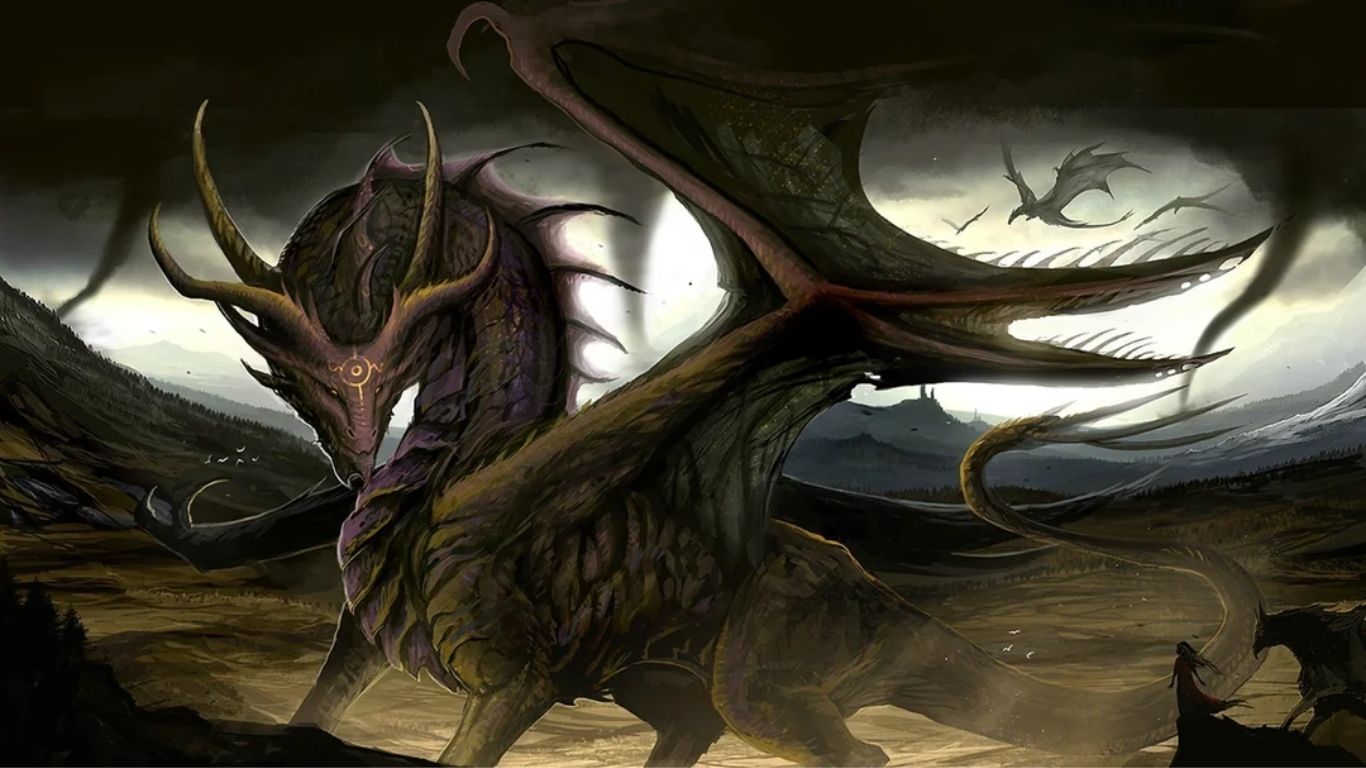
High in the mist-shrouded peaks of China, the stag-antlered Loong coils through the clouds. Halfway across the world, in the sun-drenched marshes of Greece, the multi-headed Hydra waits for a hero brave enough to face a nightmare that grows two heads for every one lost. We’ve spent millennia categorizing these beasts as ‘bedtime stories’—the product of overactive imaginations and campfire shadows. But what if we’ve been looking at them all wrong? What if dragons weren’t just fantasies, but the echoes of a restless Earth? Welcome to the world of geomythology, where we peel back the scales to find the geological heart of our greatest legends.
This is the fascinating premise of geomythology. It’s a field that suggests ancient myths aren’t just fabrications, but are actually rooted in real geological events. Beneath the scales and the fire, we find traces of nature’s raw power: volcanic eruptions, earthquakes, meteor strikes, and the petrified remains of creatures that lived long before us. In this deep dive, we’re going to peel back the layers of legend to see how the very landscapes our ancestors walked upon shaped the monsters they feared and revered.
What Exactly is Geomythology?
At its heart, geomythology is the study of how the Earth’s physical history becomes woven into folklore. It’s based on a profound realization: myths are often “cultural memories.” Before we had the scientific language to describe a tectonic shift or a thermal vent, we had stories.
When the ground split open or a mountain began to bleed fire, ancient people didn’t just stand there in silence; they tried to make sense of it. They transformed terrifying, inexplicable experiences into living narratives—records passed down through the generations. Geomythology gives us the “decoder ring” to translate these legends back into the geological events that likely inspired them.
The Universal Mystery of the Dragon
It’s a bit of a head-scratcher when you think about it: why do cultures separated by vast oceans and thousands of years all dream up similar winged, serpentine beasts? Whether they are wise deities or gold-hoarding monsters, dragons almost always control the elements—fire, wind, and water.
The answer likely isn’t a shared imagination, but a shared planet.
Dragons Born of the Earth’s Fury
Imagine a massive thunderstorm rolling across a dark valley, or a geyser suddenly erupting from a peaceful field. To an early society, these weren’t “weather patterns”; they were the movements of something alive.
- Storms and Tornadoes: A funnel cloud looks remarkably like a writhing, serpentine tail descending from the heavens.
- Volcanoes: A mountain breathing smoke and molten rock is, for all intents and purposes, a fire-breathing beast buried alive.
- Earthquakes: The violent shaking of the ground was often interpreted as the thrashing of a colossal serpent deep beneath the crust.
When Bones Tell Stories: The Fossil Connection
One of the most compelling arguments in geomythology is that fossils—the petrified remains of prehistoric giants—were the “physical proof” ancient people needed to believe in dragons.
Imagine a Greek farmer 2,500 years ago stumbling upon the massive, weathered jawbone of a mastodon. Without any concept of extinction or paleontology, what else could it be but the remains of a monster slain by a hero?
Take the myth of Cadmus. Legend says he killed a dragon and planted its teeth in the soil, which then sprouted into warriors. Interestingly, mastodon fossils, with their large, jagged molars, are common in the very soil where these myths originated. On the island of Chios, stories of a dragon with terrifying teeth coincide perfectly with modern paleontological finds of prehistoric mammal bones.
The Chinese Loong: Fossils of Fortune
In China, the dragon (or Loong) takes on a different personality. It’s a symbol of wisdom and imperial grace. But even this design seems to have geological roots.
Researchers have noted that fossilized deer skulls from the Pliocene era—found frequently across northern China—feature antlers that look uncannily like those depicted on traditional Chinese dragons. Even today, the term “dragon bones” (longgu) is used in many regions to describe fossilized remains found in the mountains.
One of the world’s most fossil-rich sites, Huanglonggou, literally translates to “Yellow Dragon Valley.” It’s a clear sign that the Chinese didn’t just imagine dragons; they dug them up.
Shimmering Scales and Living Fire
In Pakistan’s Siwalik Hills, legends tell of dragons with shimmering, jeweled scales. This detail likely comes from the calcite crystals often found embedded in the fossilized remains of Sivatherium (a prehistoric relative of the giraffe). A fossil glistening in the sun would easily look like the hide of a magical beast.
Then there’s the Chimera of Greece—a fire-breathing hybrid. The hero Bellerophon supposedly killed it by shoving lead down its throat. This myth maps almost perfectly to the Mount Chimaera (Yanartaş) region in modern-day Turkey. Here, methane gas seeps through cracks in the rock and ignites spontaneously, creating “eternal flames” that dance on the mountainside.
To an ancient traveler, the mountain itself was breathing fire.
Pele and the Star that Fell
Geomythology isn’t limited to the “Old World.” In Hawaii, the goddess Pele represents the volcanic spirit of the islands. Her myths describe her migrating from island to island, “lighting fires” as she went. When scientists looked at these stories, they realized the order of her journey matched the actual chronological age of the volcanic formations. These myths were so accurate that they actually helped geologists refine the timeline of the Kīlauea volcano’s collapse.
Perhaps most stunning is a story from Indigenous Australians about a “star falling into a waterhole.” For a long time, this was seen as pure metaphor. However, when researchers followed the geographic markers in the story, they discovered a previously unknown meteor impact crater. A story told for thousands of years had preserved the exact location of a prehistoric cosmic event.
Dragons as Messengers
Dragons may not have physically roamed our world, but their “footprints” are everywhere. They are a bridge between our spiritual past and our scientific present. Even today, paleontologists in China often use local legends of “dragon bones” to decide where to dig.
Geomythology reminds us that myth and science aren’t enemies; they’re partners. One uses data, the other uses wonder, but both are trying to explain the same thing: the living, breathing, sometimes violent Earth beneath our feet.
The next time you read about a dragon sleeping in a cave or guarding a mountain, don’t just see a fairy tale. Look for the volcano, the fossil, or the earthquake. Because under every great legend, the Earth is still speaking—if we’re willing to listen.