

Thebes stood still in the shadow of a devastating war, its streets heavy with silence and grief. The gods themselves were said to watch as the dawn broke over a city soaked in blood and betrayal. From the palace walls, Antigone—daughter of the once-great Oedipus—emerged into the pale morning light. The battle between her brothers, Eteocles and Polyneices, had left both dead, their bodies lying at the gates of the very city they fought to rule. The aftermath was chaos. Thebes, once led by her father, had fallen into despair and confusion.
Creon, Oedipus’ brother-in-law, seized this moment to take power. Aligning himself with Eteocles during the conflict, he branded Polyneices a traitor, decreeing that his body should be left unburied, food for vultures and crows. To deny someone burial was the ultimate dishonor—a punishment that extended beyond death, condemning the soul to eternal unrest. Anyone who dared to defy this white-royal-blue-by-casey-mcquiston/”>royal order, Creon warned, would be stoned to death in the city square.
For Antigone, this was not merely a political decree—it was a moral outrage. The divine law of the gods demanded that secret-by-a-r-torre/”>every person be given the rites of burial. It was not just custom; it was sacred duty. And though she knew Creon’s wrath would be merciless, she resolved to do what was right, even if it cost her life.
The Sisters’ Divided Path: Duty and Fear
In the quiet of dawn, Antigone sought out her sister, Ismene. The two women stood as opposites in both temperament and conviction. Ismene, gentle and cautious, understood the peril of defying men in power. Antigone, fierce and resolute, saw only the injustice that burned before her.
Antigone whispered her plan: she would bury their brother Polyneices herself, even if it meant certain death. Ismene’s face paled with fear. “We are only women,” she pleaded. “We cannot fight against men, against the king. We must obey.”
But Antigone’s voice did not waver. “He is my brother,” she replied. “I will not be caught betraying him by inaction. The laws of the gods are greater than the laws of men.”
With that, the sisters’ paths diverged—Ismene to the safety of silence, Antigone to the peril of rebellion. Alone, Antigone crept to the battlefield where Polyneices’ body lay. The air was thick with decay, the ground still stained by roses-are-blood-red/”>blood. Kneeling beside her brother, she began to sprinkle dust over his corpse, whispering prayers to the gods below. It was a simple act—one handful of earth—but in that moment, it was an act of defiance that would shake a kingdom.
Creon’s Edict and the Defiant Burial
When the guards discovered that someone had disturbed the unburied body, they rushed to Creon with the news. Enraged, the king demanded that the culprit be found and brought before him. He could not tolerate insubordination; his authority depended on fear and absolute obedience.
But Antigone was not done. She returned to the battlefield at midday, determined to complete her brother’s burial. As if the gods themselves approved of her courage, a sudden dust storm swept across the plain. The sky darkened, and the wind howled, blinding the guards and covering the ground with swirling sand. In the midst of this divine tempest, Antigone moved unseen. She poured water and dust over Polyneices’ body, completing the sacred rites.
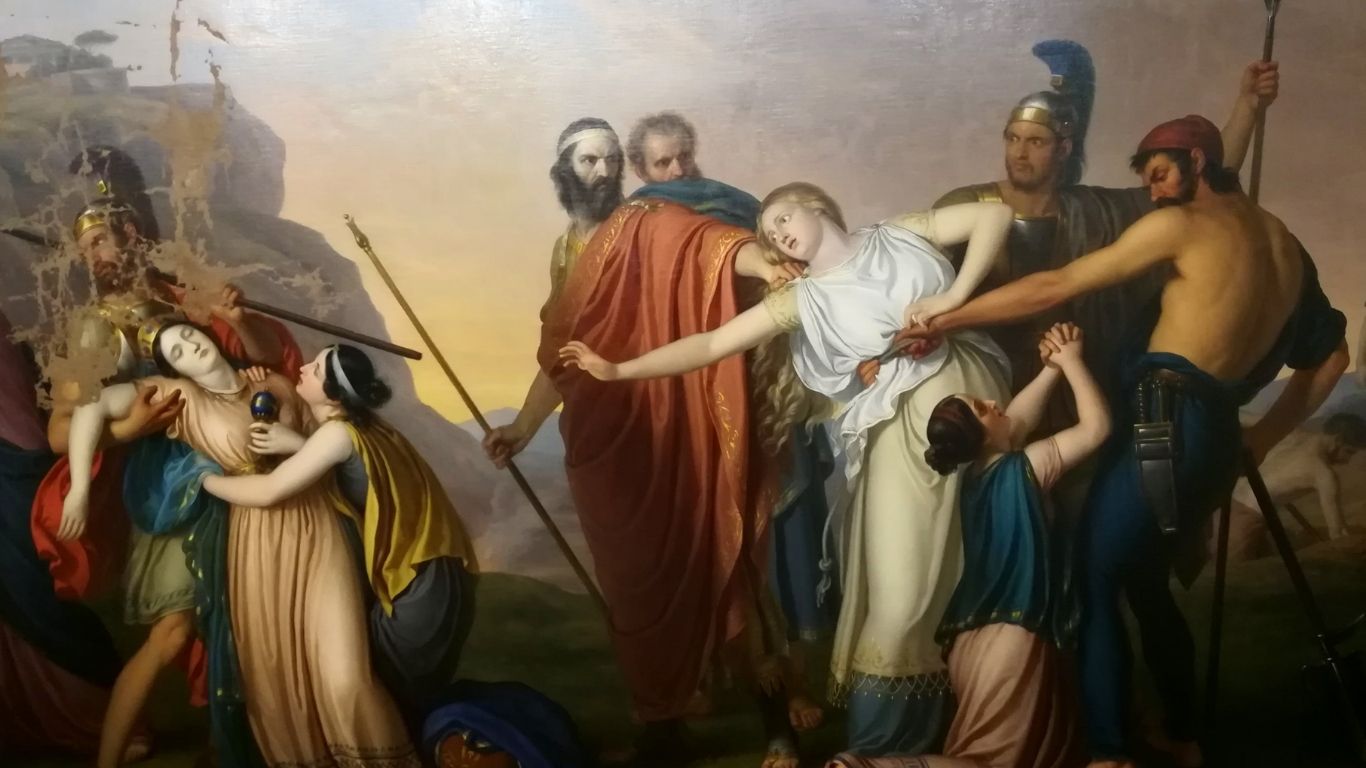
When the storm cleared, the soldiers were stunned to find the culprit—a young woman, the princess of Thebes herself. Dragged before Creon, Antigone stood proud, her face calm though death awaited her. The guards expected her to plead, to deny—but she confessed freely.
“Yes,” she said. “I did it. I do not deny it. Your decree was not the law of the gods. I owe more allegiance to the laws of heaven than to those of any mortal king.”
The Clash of Pride and Piety
Creon could scarcely contain his fury. His pride was wounded not just by the disobedience, but by the fact that it came from a woman. He hurled accusations and insults, calling her reckless, arrogant, and foolish. Ismene, overcome with guilt, stepped forward and claimed she shared the blame, hoping to die alongside her sister. But Antigone rejected her confession.
“I did not ask for your help,” Antigone said sharply. “Nor do I wish you to share in my death. You chose to live; I chose to die.”
The court fell silent. Antigone’s defiance echoed like thunder in the marble halls. Creon turned to his son, Haemon—Antigone’s betrothed—expecting his support. But Haemon pleaded for mercy instead. He begged his father to listen to reason, to honor the courage and moral strength of the woman he loved.
“Do not be so rigid,” Haemon implored. “No man can rule well if he rules without wisdom or compassion.”
But Creon, blinded by pride, refused to yield. To him, mercy was weakness, and weakness was the death of kings. His decision was final: Ismene would live, but Antigone must die. However, to avoid direct guilt for her execution, he chose a cruel compromise. Antigone would be sealed alive in an underground cave, left to starve, alone with the gods she so fervently served.
Antigone’s Living Tomb: The Price of Conviction
Dragged through the streets, Antigone walked toward her living grave. The people of Thebes watched in silence, their hearts heavy with sorrow and fear. Though none dared speak openly, many wept for her. She was young, brave, and unyielding—sacrificed to the arrogance of a king.
Inside the cave, Antigone accepted her fate with tragic grace. She mourned not for herself but for those she left behind—for her sister, for her betrothed, for the cursed house of Oedipus that could never escape its doom. In the darkness, she tied the veil from her wedding garment and prepared to meet death on her own terms. If Creon would not let her bury her brother in peace, then she would bury herself.
The Warning of Tiresias: The Gods’ Judgment
Back in Thebes, Creon’s confidence began to waver. Whispers of unrest reached his ears. Then came the blind prophet Tiresias, led by a young boy. Tiresias’ words were filled with warning and wrath.
“You have defied the gods,” he told Creon. “Your stubborn pride has polluted Thebes. The Furies stir in the underworld. If you do not yield, death will come swiftly to your house.”
At first, Creon accused the prophet of deceit, claiming he sought to manipulate him. But soon, the truth in Tiresias’ words became undeniable. Fear gripped the king’s heart. Finally, too late, he ordered that Polyneices be given a proper burial and that Antigone be freed from her tomb.
The Final Tragedy: Love and Death Entwined
Creon’s change of heart came too late. When his guards arrived at the cave, the air was still, heavy with sorrow. Haemon had reached the tomb before them, desperate to save his beloved. But what he found was horror—Antigone hanging lifeless from the veil she had worn for their never-to-be wedding.
Grief and rage consumed him. When Creon entered the chamber, Haemon glared at his father with hatred burning in his eyes. He spat in Creon’s face and drew his sword, lunging at him. Creon stepped aside, and Haemon, in despair, turned the blade upon himself. Dying, he embraced Antigone one final time, their bodies entwined in eternal unity.
When word of their deaths reached the palace, Creon’s wife, the queen, took her own life at the altar, cursing her husband with her final breath. The prophecy had come true—Creon’s pride had destroyed his family, his lineage, and his soul.
Creon’s Descent: The Price of Pride
Alone and broken, Creon staggered back to his palace, his hands stained with the blood of his own son. The people turned their faces away as their king passed by—a man stripped of all dignity, all power, all love. He had tried to rule through fear, but in doing so, he had only sown despair.
Antigone’s rebellion had not been in vain. Though she died, her act of defiance lived on as a testament to the power of conscience over authority, divine law over human arrogance. Her courage revealed the folly of tyranny and the destructive cost of pride.
The Enduring Legacy of Antigone
The tragedy of Antigone endures because it asks timeless questions: What do we owe to the laws of man, and what do we owe to the laws of the gods? When does obedience become complicity? And how much should one risk for what is right?
In Antigone’s defiance, we see the strength of conviction—the willingness to stand alone against injustice. In Creon’s downfall, we see the danger of pride and the blindness that comes from power untempered by humility.
Her story is not merely ancient myth; it is a mirror held up to every age. As long as humans struggle between duty and conscience, between authority and morality, the tale of Antigone will continue to speak to us. She may have perished, but her spirit lives on—a symbol of moral courage that no tomb could contain.