
When it comes to the Joker, every iteration across DC’s multiverse brings a new layer of chaos. But what Scott Snyder and Jock crafted in Absolute Batman #15 goes far beyond the deranged clown we know. This “Absolute Joker” isn’t merely a madman or criminal genius — he’s something primordial, a centuries-old entity whose roots are intertwined with Gotham’s darkest history.
Absolute Batman #15 finally reveals the twisted origin of the Absolute Joker — a character who blurs the line between myth, immortality, and horror. Let’s unravel this layered narrative, piece by piece, through Alfred Pennyworth’s chilling confession to Bruce Wayne.
The Confession: A Tale Too Long Buried
The midnight-a-story-of-hope-justice-and-freedom-by-brittany-k-barnett/”>story begins not with Batman himself, but with a reluctant Alfred. The tone is immediately somber — Alfred Pennyworth tells Bruce Wayne, “It’s time, kid. I’ve put it off as long as I could, but I need to tell you about him.”
That line sets the tone: secrecy, guilt, and fear converge. Alfred hasn’t been silent because he forgot — he’s been silent because even he doesn’t understand the truth behind the monster he’s been chasing.
From here, Absolute Batman #15 dives into a visual mosaic — newspaper clippings, surveillance photos, and scattered reports. All of them revolve around one enigmatic name: Jack Grim.
This is where the “Absolute Joker” begins to take shape — not as a single criminal, but as the head of a dynasty. A family-upstairs-by-lisa-jewell/”>family empire that spans centuries and industries: from early film, to broadcasting, to global philanthropy. On the surface, the Grims are Gotham’s forgotten benefactors. Beneath the surface, however, they are the architects of chaos itself.
The First Grim: The Laugh That Never Ends
The first figure in this cursed lineage is Joseph “Jack” Grim I, a haunting-of-brynn-wilder-by-wendy-webb/”>haunting boy who appeared in one of Gotham’s first motion pictures — a silent reel from 1888. In the flickering grain of the film, he performs in clown makeup, juggling skulls in the street.
A boy juggling skulls might have seemed quaint in the 19th century — but Alfred’s narration carries quiet horror. This wasn’t a child playing dress-up. This was an omen.
Jack Grim I grew up as an orphan on the streets of Gotham. His talent was laughter — yet he never actually laughed himself. His performances drew crowds, the sound of amusement spreading through the city like a contagion. Over time, his notoriety grew, leading him to vaudeville, and later to silent film production. Every step of his career, however, came with mystery: rivals dying tragic deaths, investments turning to fortune overnight.
By forty, Jack Grim I was rich enough to join Gotham’s oldest elite clubs, mingling with industrialists and philanthropists like Rockefeller and Carnegie. Public records describe him as generous — a self-made man dedicated to “children’s happiness.” But as Alfred ominously notes, “Live like a clown, leave the world with more laughter than you entered,” doesn’t sound heartwarming once you realize who’s saying it.
When Grim I died in 1938, no one questioned the end of an era. But that end was only an illusion.
The Generations of Jack: Laughter Across Time
From here, the “Grim Dynasty” unfolds like a corporate genealogy chart corrupted by rot.
- Jack Grim II (the son) expanded the empire into early television, financing children’s entertainment and variety shows.
- Jack Grim III moved into cable networks, centered on comedy programming. He became the smiling face of mass laughter in mid-century America.
- Jack Grim IV took things digital, developing gaming systems and international charities.
- And Jack Grim V, the so-called “Absolute Joker,” pushed into the tech age — investing in GPUs, online gaming, and global philanthropy.
Each generation seemed more benevolent than the last. Each one obsessed with “making the world smile.” Yet every Grim’s story carries the same strange constant — a missing paper trail, shadowed wealth, and lives ended abruptly around them.
Bruce Wayne’s skepticism grows as Alfred recounts this history. Everything sounds too perfect — a billionaire family dedicated to joy and laughter, yet leaving trails of death and disappearance. So Bruce demands: “Tell me what you believe, Pennyworth. Forget what’s true; tell me what’s real to you.”
And that’s where the story turns from mystery to nightmare.
The Trick of the Laughing Boy
Alfred rewinds the story — back to that alley in the 1880s. Back to the boy clown. Young Jack Grim’s first “act” wasn’t just juggling or performance art. He performed outside a dentist’s office that used nitrous oxide — laughing gas. Sneaking into their equipment, he would vent the gas into the streets, making onlookers laugh uncontrollably. In their delirium, they’d hand him their coins, hypnotized by the shared laughter.
It’s a powerful metaphor: the gas becomes a symbol of the Joker’s lasting grip over Gotham. He doesn’t just make people laugh; he manipulates them into surrendering control.
From then on, Alfred suggests, the Grim family carried this same pattern across history — financing entertainment and its counter-opposite. They funded both sides of wars, both left and right-wing media outlets, aid organizations and those who steal from them. Wherever there was order, they sowed chaos — all while profiting from the confusion they engineered.
By now, Bruce and readers alike begin to see it clearly: this isn’t a family business. It’s an infection that has silently adapted across eras.
The Puppet Master of the Modern World
When we finally meet Jack Grim V, the fifth heir to the empire, he seems unstoppable — a near-trillionaire who owns entire industries across the planet. A philanthropist admired by the public. But to Alfred, he’s the same boy from the silent film — unchanged.
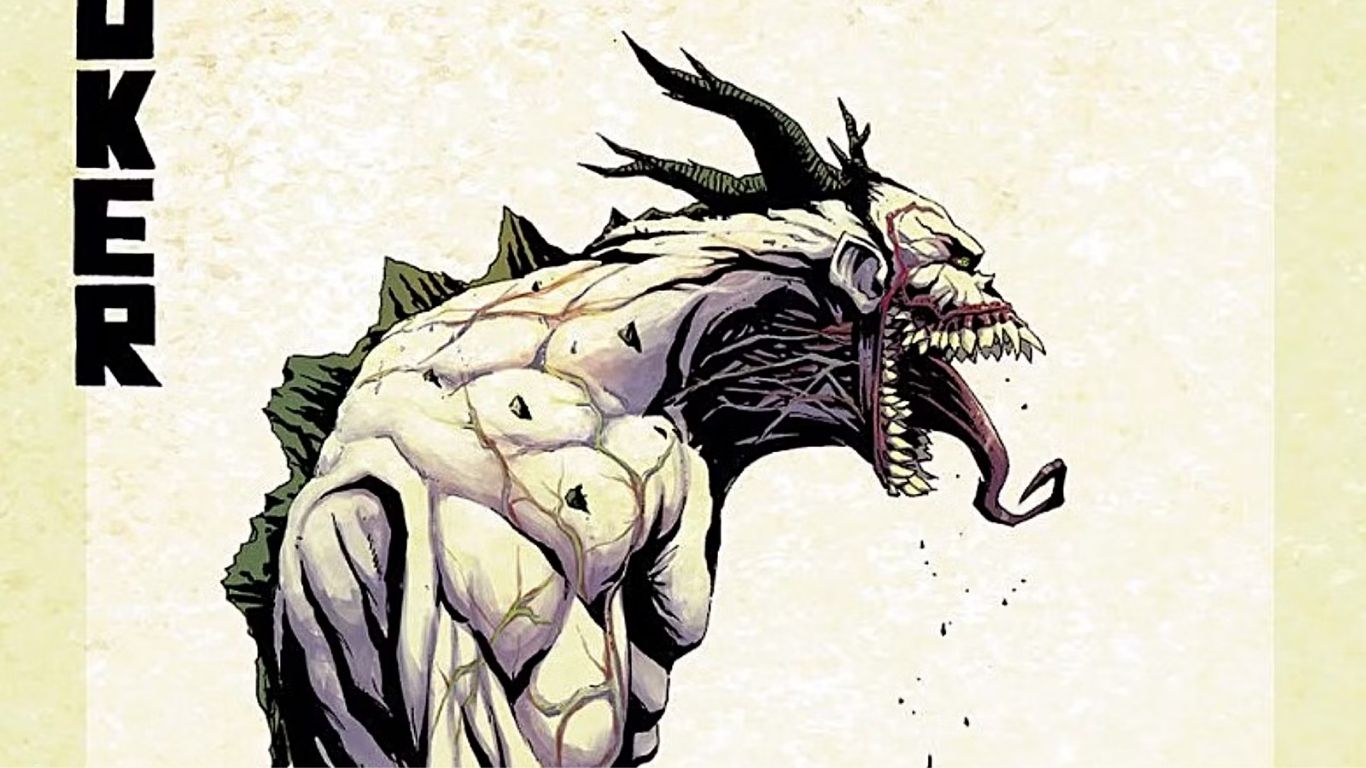
This version of Joker doesn’t rely on chemicals or clown gimmicks. His power is global, subtle, systemic. He is the 21st-century devil disguised as a CEO. His “islands” — hundreds of barren territories scattered worldwide — become points of speculation. No one knows what he builds there. No satellites detect activity. But we soon learn what happens to people who do end up there.
And that brings us to one of the issue’s most horrifying scenes.
The Island: Predator and Prey
On one of those islands, the Absolute Joker arrives in a private jet. He’s calm, calculated, dressed in white, surveying his new playground. There, he finds a lone castaway — a man who’s been stranded for thirty years, overjoyed to finally see another human.
But when the castaway recognizes Jack Grim, he stumbles back in horror. “It can’t be you,” he whispers. The realization strikes like lightning — this is the same man he saw decades ago, unchanged, ageless.
As the Joker approaches with a smile, he commands one simple word: “Run.”
The sequence grows deeply unsettling. The Joker hunts the man across the island, like prey. His skin twists, his smile elongates, his features warp into something inhuman. By the end, the monster tears his victim apart — literally devouring him.
Over this scene, Alfred’s voice continues to narrate — connecting the historical and the horrific. He speaks of victims who all met uncanny ends, of toxins that kill by forcing the body into a “permanent grin.”
And his conclusion is chilling: those smiling corpses weren’t just victims of poison. They were the Joker’s eternal joke.
Pennyworth’s Truth: There Was Never a Family
Finally, Bruce demands the truth. No more reports, no more theories — what does Alfred truly believe?
And Alfred breaks. He confesses what his rational mind cannot prove, but his soul knows to be true:
“There was never a Grim family, Bruce. No Jack the First, Second, Third, or Fifth — there’s only ever been one Jack Grim.”
That revelation changes everything. The “Grim Dynasty” isn’t a family tree — it’s one immortal being, rebirthing himself era after era, evolving with human history.
Was it science? Sorcery? A deal with death itself? Alfred can’t say. But the evidence points to biological horror. The Joker has spent centuries experimenting with regenerative elixirs derived from living children — possibly the same disturbing process glimpsed in earlier Absolute Batman issues, where fetuses were attached to his body like organic batteries.
This detail ties to Snyder’s recurring theme: the Joker as evolution’s cruel joke. In every age, he adapts — from jester to industrialist, from clown to god. His laughter outlives civilization.
The Monster in the Mirror
In mythological terms, Alfred’s reflection brings terrifying clarity. “What is a clown?” he asks. “A clown plays the fool — but the act itself mocks humanity. The clown hates us.”
That line reframes everything about the Joker’s character. His makeup isn’t disguise; it’s the truest reflection of what he is — a predator amused by our delusions of order. He sees humanity’s struggle for meaning as comedy, our morality as self-parody.
In this interpretation, the Joker isn’t human pretending to be a demon — he’s a demon pretending to be human.
And in the Absolute Continuity, that makes horrifying sense. The Absolute Joker isn’t chaos for chaos’s sake. He’s the architect of suffering, the one who has been laughing at us since the dawn of industrial Gotham.
The Final Twist: The Joker Has a Cave
As Bruce dons the cape and leaves to pursue his enemy, Alfred reflects privately: maybe he told Bruce the truth not to help him, but because he couldn’t bear to hide it any longer. His guilt is immense — a man of faith confessing to a godless revelation.
Then comes the last page, and with it, one of the most brilliant reversals in recent DC storytelling.
As Batman swings across Gotham’s skyline, we see the Joker watching from the street below.
Contrary to Alfred’s assumption that the villain was “3,000 miles away,” the Absolute Joker is already home — walking Gotham’s streets like a ghost. He returns to his mansion, where a butler greets him with a chillingly familiar tone: “Welcome back to the manor, Master Grim. Are you hungry?”
The Joker’s reply? “No… I ate.”
From the devoured castaway to this quiet dinner scene, the double meaning lands like a gut punch. Then, the final horror — Grim sets the clock hands to 10:47, revealing a hidden passage that leads into his underground lair. His version of the Batcave.
The parallels are unmistakable. The Absolute Joker isn’t just Batman’s opposite; he’s his mirror. Two billionaires with caves beneath their estates — one born of vengeance, the other born of mockery.
Symbolism of the Clown’s Hour: 10:47
The time 10:47 is no throwaway number. In mainstream Batman lore, Bruce sets his grandfather clock to 10:47 PM — the exact minute his parents were murdered — to unlock the Batcave.
By giving the Joker the same method, Snyder and Jock imply a horrifying symmetry. Perhaps 10:47 represents the birth of the Joker’s own enlightenment — the minute he “became” something beyond human. It’s a mocking counterpart to Bruce’s trauma. For every tragedy that gives birth to a hero, there’s a twisted laugh that gives birth to evil.
A Demon for the Modern Age
Snyder’s take on the Joker here is layered beyond any single origin story. He’s not a failed comedian or a criminal shaped by bad luck — he’s the archetype of corruption itself.
The Absolute Joker represents humanity’s fixation on spectacle — the need to laugh at tragedy, to turn pain into profit. Each “Jack Grim” is another century where laughter hides cruelty. The family’s philanthropy mirrors real-world power structures — billionaires funding both wars and charities, chaos disguised as compassion.
It’s social commentary disguised as cosmic horror. Gotham becomes a reflection of the modern world, where smiles mask suffering, and the people behind them hold dominion over everything.
What Comes Next: The Clown vs. The Bat
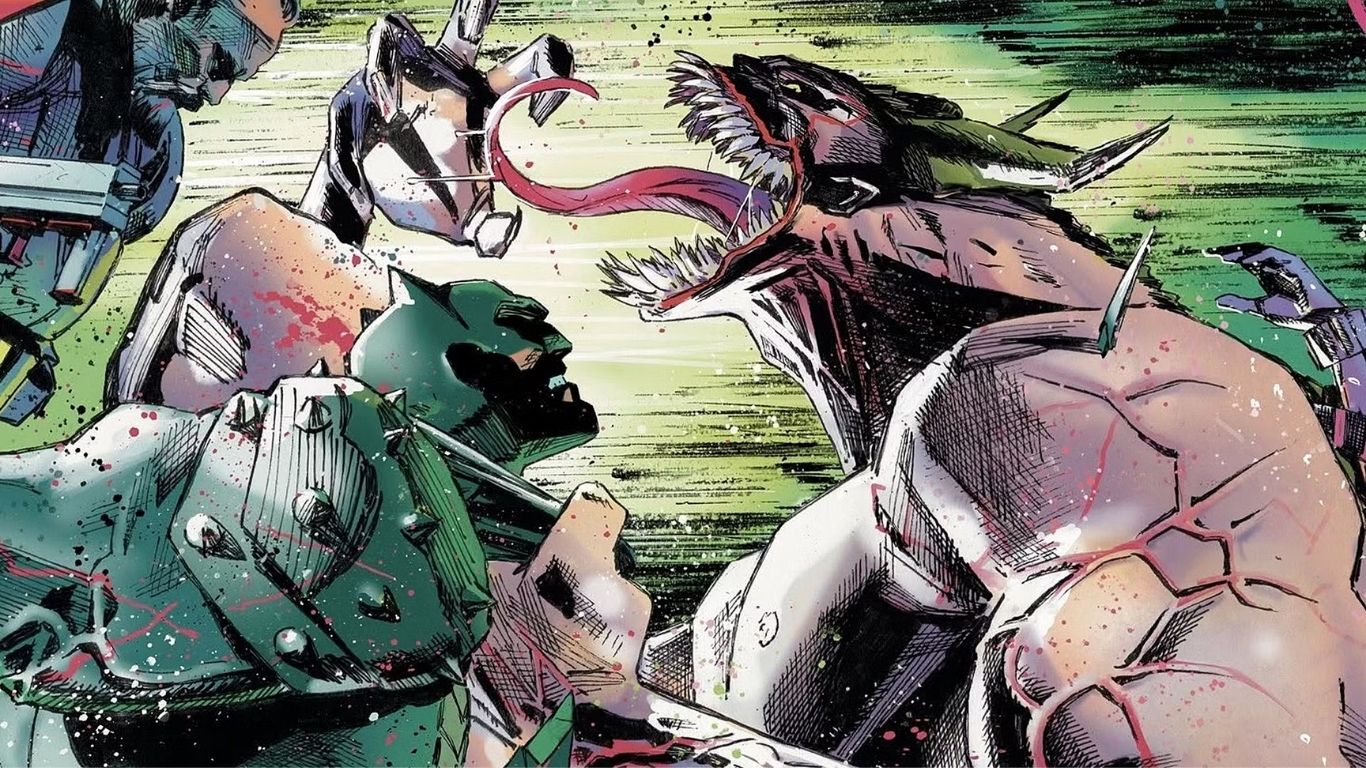
The issue closes on Batman’s vow to investigate, unaware that his adversary stands in the same city, plotting his next spectacle. The stage is set for the inevitable confrontation: the Absolute Batman versus the Absolute Joker — two icons of willpower and madness finally colliding on equal footing.
Considering the scale of their power in this universe, this battle might redefine what good and evil even mean. And with the tease of Absolute Wonder Woman #15 next, the saga may expand the mythology even further — drawing on gods, demons, and archetypes that mirror these two mortal monsters.
Final Thoughts: The Eternal Laugh
The origin of the Absolute Joker is more than a horror story — it’s a mythic revelation. Snyder and Jock use the language of history, capitalism, and madness to craft something truly unsettling: the Joker not as a broken man, but as an immortal principle of destruction.
Every generation paints its clowns differently. But this one — this immortal orchestrator who feeds on the souls of orphans, hides behind philanthropy, and mocks humans from behind a perfect smile — feels all too real.
He isn’t just Gotham’s nightmare.
He’s the world’s reflection — laughing, always laughing, as the rest of us pretend it’s all just an act.