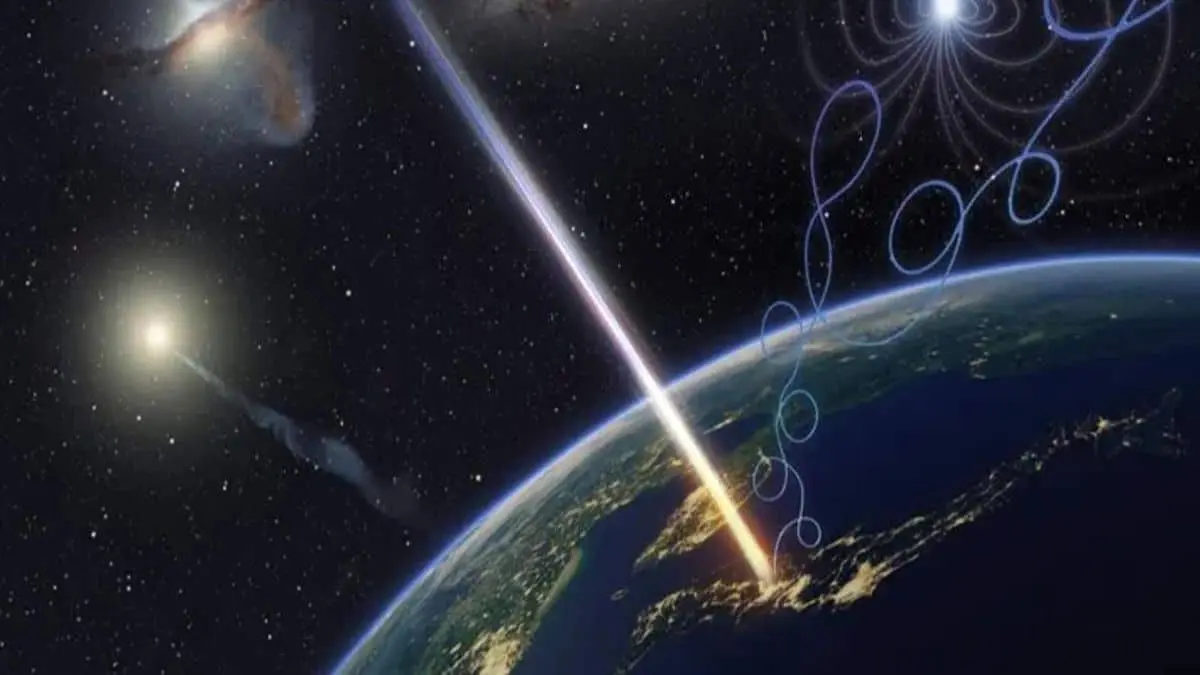
Scientists Discover the ‘Sun Goddess’ Particle: Over recent years, the field of particle physics has witnessed groundbreaking discoveries. Following the revelation of the Higgs Boson, known as the “God Particle,” and the ultra-high-energy cosmic ray called the “Oh My God!” particle, scientists have now unearthed a new subatomic marvel. This newly discovered particle surpasses previous findings in energy levels and mystique.
The Amaterasu Particle: A Cosmic Phenomenon
Dubbed the Amaterasu particle, after the ‘Sun Goddess’ in Japanese mythology, this subatomic particle was discovered at the cosmic ray observatory in Utah’s West Desert, part of the Telescope Array project. Its energy is astounding, estimated to be a million times greater than what the most potent particle accelerators on Earth can generate. This extraordinary find underscores the vastness and Mystery of the cosmos that lies beyond our current scientific grasp.
Discovery and Characteristics
The Telescope Array detected the ‘Sun Goddess’ particle on May 27, 2021. This event was notable as it activated 23 out of 507 surface detectors, each the size of a ping-pong table. The calculated energy of the Amaterasu particle is about 244 exa-electron volts (1 exa-electron volt equals 1 billion gigaelectron-volts). For context, the “Oh My God particle” detected in 1991 had an energy of 320 exa-electron volts, and in comparison, an electron in the polar aurora carries about 40,000 electron volts.

Background Information
Central to this exploration are subatomic particles, the basic building blocks of matter. Two such discoveries, the ‘God Particle’ and the ‘Oh My God!’ particle, have significantly shaped our understanding of the universe, paving the way for the latest revelation – the ‘Sun Goddess’ particle.
The ‘God Particle’ – Higgs Boson
- Discovery: The ‘God Particle’, officially known as the Higgs boson, was confirmed in 2012 at the Large Hadron Collider (LHC) at CERN. Its existence had been postulated in 1964 by physicist Peter Higgs, among others, but remained elusive for decades.
- Importance: This particle is integral to the Standard Model of particle physics. It is associated with the Higgs field, which permeates the universe. The interaction of particles with this field is what gives them mass. The discovery of the Higgs boson provided a crucial confirmation of the mechanism that explains how elementary particles acquire mass, a question that had baffled scientists for much of the 20th century.
The ‘Oh My God!’ Particle
- Discovery: The ‘Oh My God!’ particle was observed in 1991 by the Fly’s Eye Camera in Utah. This particle, a cosmic ray, possessed an energy level so high that it led to exclamations of disbelief, hence its name.
- Significance: It challenged existing knowledge about the limits of energy and speed in the universe. The energy of this particle was so immense that it raised questions about its origin and the physical processes capable of producing such high-energy particles. Its detection played a crucial role in advancing the field of astrophysics, particularly in the study of cosmic rays and high-energy space phenomena.
The Enigma of Origin
While the massive energy of the Amaterasu particle is clear, its origin remains a profound Mystery. Cosmic rays, in general, are believed to be produced by cataclysmic astronomical events such as black holes, gamma-ray bursts, and neutron star collapses. However, the Amaterasu particle seems to originate from the Local Void, an empty region adjacent to the Milky Way galaxy. This baffling origin challenges our current understanding of cosmic events and their capacity to generate such high-energy particles.
Scientific Implications and Future Endeavors
Despite the uncertainty surrounding its origin, the ‘Sun Goddess’ particle is considered an essential messenger from the universe. It holds clues to highly energetic events that are yet to be deciphered. The scientific community agrees that further research is necessary to unravel the mysteries of this particle. The pursuit to understand the Amaterasu particle will not only shed light on cosmic ray origins but also potentially unlock new aspects of our universe’s structure and behavior.
Also Read: Bill Gates believes that AI won’t replace humans but could pave the way for a 3-day workweek