
There’s a moment in nearly every great horror comic where the reader’s pulse quickens—not because of what’s visible on the page, but because of what’s deliberately withheld. A shadow stretching across an empty hallway. A character’s face locked mid-scream as the panel abruptly shifts to a quiet night skyline. A door left slightly open, darkness seeping through the narrow gap. These instances reveal how Sequential Art masterfully handles Unseen Terror, turning absence into something far more unsettling than presence. Horror in comics has never relied solely on what is illustrated. From the ink-soaked dread of EC Comics’ Tales from the Crypt to the fragmented, disorienting layouts of modern works like Gideon Falls and Wytches, the medium has consistently thrived on implication over exposition. The most effective stories understand a crucial, almost paradoxical idea: what remains hidden lingers longer in the mind than anything fully revealed. This exploration dives into how Sequential Art masterfully handles Unseen Terror—shaping it, sustaining it, and ultimately using it as one of its most powerful storytelling tools.
The Gutter: Where Horror Actually Lives
Before we talk about monsters and shadows and things that go bump in the dark, we need to talk about something that most readers never consciously notice. We need to talk about the gutter.
In comics terminology, the gutter is the blank space between panels. That thin strip of white (or black, or whatever color the artist chooses) that separates one frozen moment from the next. It seems like nothing. It is, in fact, everything.
Comics theorist Scott McCloud, in his landmark 1993 work Understanding Comics, gave this concept its most famous articulation. He described how the reader’s mind doesn’t passively receive a comic the way an eye receives light — it actively completes it. The imagination picks up two separate images on either side of the gutter and bridges them, constructing the action, the emotion, or the event that connects the two. McCloud called this phenomenon “closure,” and he illustrated it with a deceptively chilling example: in one panel, a man raises an axe over a cowering victim. In the next panel, a city skyline at night, with the word “EEYAA!!” printed above the rooftops. What happened in between? McCloud’s point was that the reader happened. Every person who read that sequence committed the act themselves — in their own imagination, in their own way.
This is the foundational secret of horror in sequential art. The gutter is where the horror lives. It is a space that belongs entirely to the reader’s mind, and the mind, as any psychologist or horror writer will tell you, is capable of generating terrors far more personalized and visceral than anything an artist’s hand can render. The comic artist’s job, then, is not to show the monster. It’s to open the door and let the reader’s imagination walk through it.
Horror thrives in this space more than any other genre because horror, at its core, is about the unknown. It’s about the thing lurking just beyond the edge of perception. Sequential art, by its very nature, is a medium built on gaps — and the most skilled horror creators have learned to make those gaps yawn open like an abyss.
Shadows, Angles, and the Architecture of Dread
Of course, the gutter alone doesn’t do the heavy lifting. What a creator chooses to show in the panels themselves is just as important — perhaps more so — because those images are the bait. They are the breadcrumbs that lead the reader toward the darkness the artist wants them to conjure.
Horror comics have historically used shadow as their primary language. Graham Ingels, one of the great artists of EC Comics’ golden era in the early 1950s, was famous for dense, layered crosshatching that rendered encroaching darkness with a kind of textural menace — not just depicting shadow, but making it feel like a physical presence pressing in from the edges of the frame. His work in The Haunt of Fear understood that what darkness implied was always worse than what it revealed, and so his shadows were always strategically placed to obscure just enough.
Panel angles play an equally significant role. A worm’s-eye view — looking up at a figure — doesn’t just show you a person; it makes them loom, it makes them enormous, it places the reader in the position of someone vulnerable and low to the ground. Sequential art borrows this grammar directly from cinema, and horror comics use it with ruthless efficiency. A low angle on a doorway tells you something dreadful is about to come through it. A bird’s-eye view looking down at a character in an empty room communicates isolation and surveillance simultaneously. The reader feels watched even when there is nothing visible doing the watching.
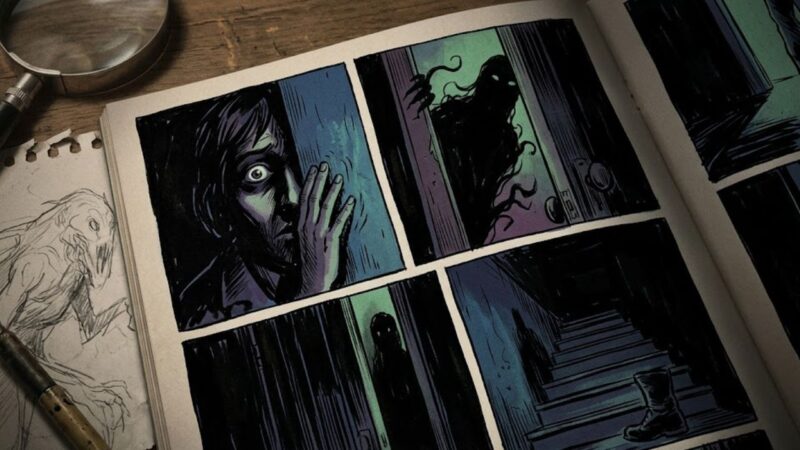
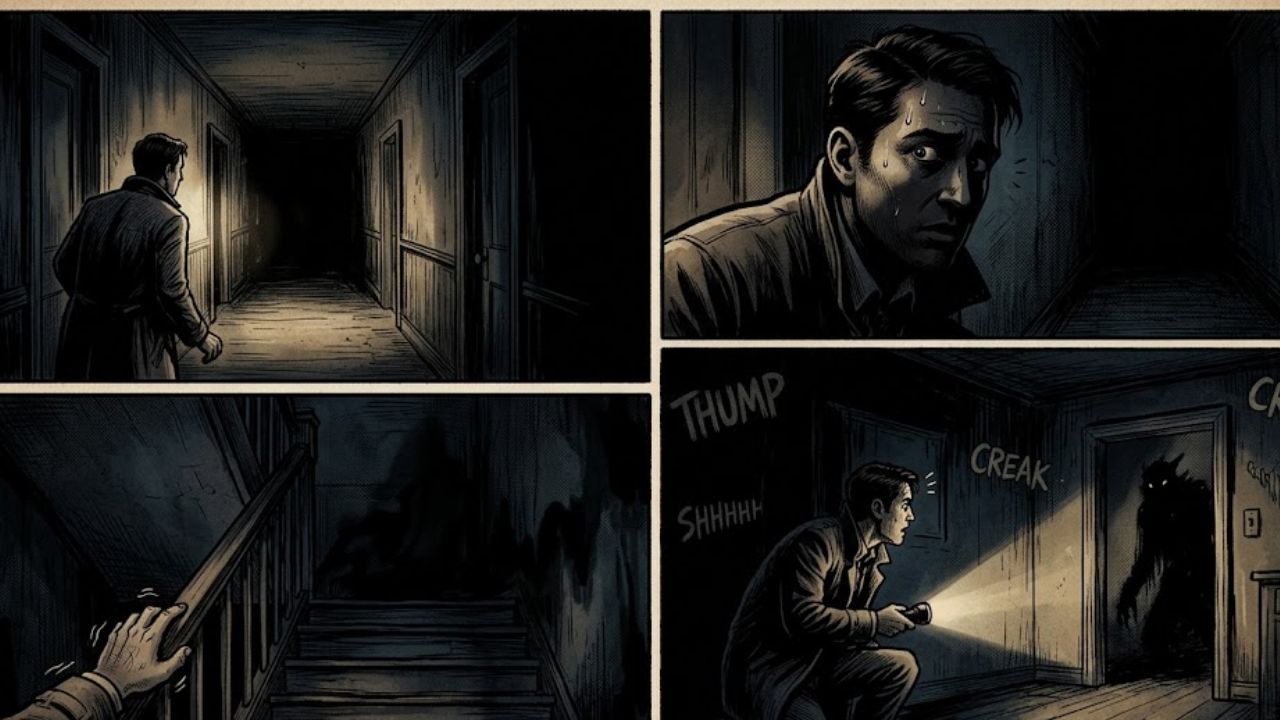
This is a key distinction in effective horror comics: the suggestion of being observed without confirmation of an observer. Empty spaces in panel backgrounds — doorways, windows, dark corners — are never truly neutral in horror sequential art. They are charged with potential. The eye travels to them precisely because the artist has framed the scene in a way that makes the emptiness feel unnatural. You find yourself scanning the background of a panel the way you might scan a dark room after hearing an unexpected sound. Your instincts are telling you something is there. The page isn’t confirming it. And that tension is exquisite.
What You See in the Character’s Eyes
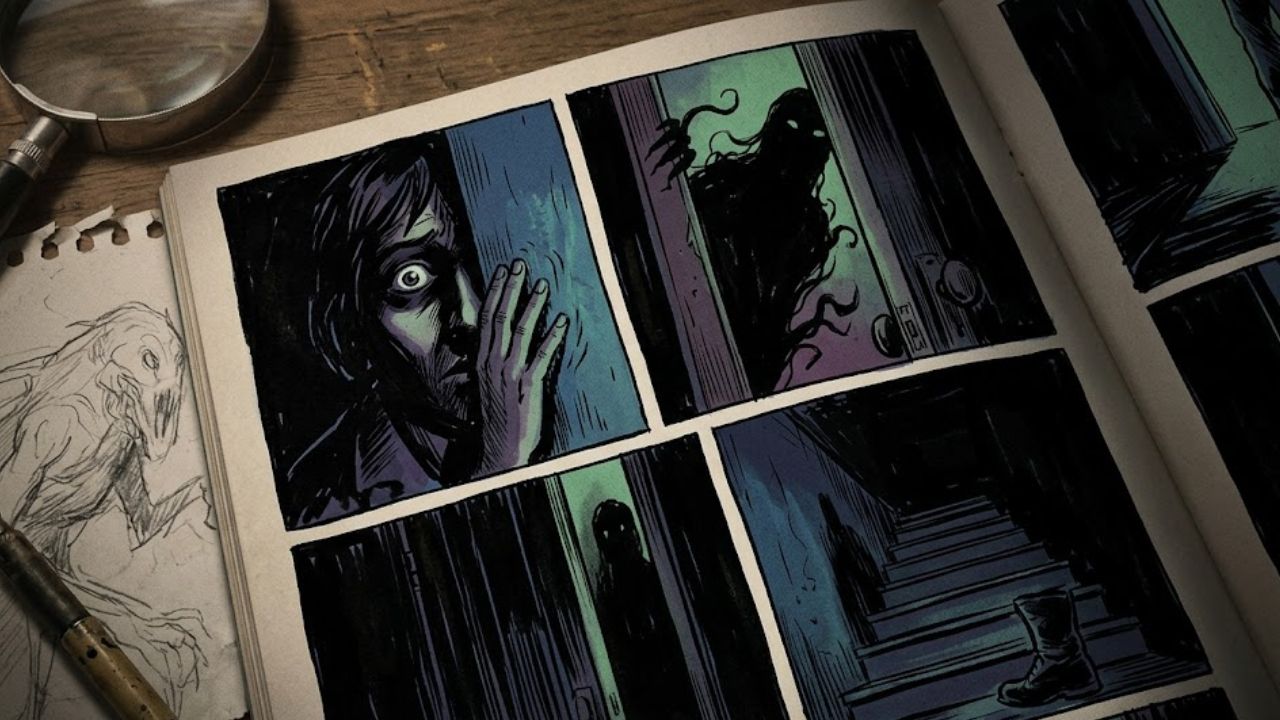
One of the most powerful techniques sequential art uses to convey unseen terror is reflexive: showing us the character seeing something we cannot. Horror comics do this constantly, and it works every time because of simple psychological mechanics. When we see a human face register pure, unfiltered terror, our mirror neurons fire. We feel a version of that fear ourselves. And when the source of that terror is deliberately withheld — when the next panel is a reaction shot rather than a reveal — that fear has nowhere to go but inward.
Think about how often a horror comic ends a page on a character’s face, jaw slack, pupils dilated, body frozen, looking at something just off-panel or just outside the frame. The page turns. And rather than getting the monster, you get the aftermath — or worse, nothing at all, a scene-change, a cut-away that leaves the horror entirely up to you. Master horror artists understand that this technique works precisely because the human imagination will not tolerate a vacuum. Give the reader a terrified face and withhold the cause, and their mind will manufacture something. And what their mind manufactures will be, by definition, the thing they personally find most frightening.
Scott Snyder and artist Jock weaponize this beautifully in Wytches, a series where the creatures stalking the characters are almost always partially hidden — glimpsed behind trees, suggested in the shadows of the forest, reduced to limbs and negative space. When you do see them clearly, it’s almost a relief — but only momentarily, because Jock’s scratchy, distressed art style ensures that even the fully visible still looks wrong, still looks like something that shouldn’t exist in the ordered world of a panel. The art style itself becomes part of the horror. Colorist Matt Hollingsworth adds to this with splatters and washes of color that look less like deliberate composition and more like something seeping through, something staining the clean surface of the page.
Panel Layout as Psychological Control
The physical architecture of a comic page — how panels are sized, shaped, arranged, and bordered — is one of the most underappreciated tools in a horror creator’s kit. Horror comics use panel design not just for pacing, but for deliberate psychological disruption.
Asymmetrical layouts create visual unease. When panels are different sizes and irregular shapes, the eye doesn’t know where to travel next — and that disorientation mirrors the psychological state of a character (or a reader) experiencing genuine fear. The rational grid of a calm, ordered page signals safety. The moment that grid starts breaking down, the reader’s nervous system picks up the signal.
Jeff Lemire and Andrea Sorrentino’s Gideon Falls is perhaps the most sophisticated modern example of this. Sorrentino’s panel arrangements are frequently fractured and non-linear, with images overlapping, bleeding into each other, or arranged in jagged configurations that feel like a mind coming apart at the seams. Panels that mirror fragmented thinking don’t just illustrate a character’s paranoia — they induce a version of it in the reader. You find yourself unsure of the sequence, unsure of what is real within the story’s world, and that uncertainty maps perfectly onto the cosmic horror Lemire is telling.
Decompression — stretching a single moment across multiple panels — is another key technique. When a character slowly reaches for a door handle across four panels instead of one, the tension doesn’t decrease; it compounds. You are being forced to linger in the moment before something happens, which is, psychologically, the most terrifying place to be. Horror is not in the event. Horror is in the anticipation of the event. Sequential art can sustain that anticipation in a way that no other medium quite manages, because it controls exactly how long you spend in each moment.
Conversely, the panel bleed — when an image extends beyond the borders of its frame and out into the gutter or off the edge of the page entirely — communicates the uncontainability of whatever is depicted. When a monster or a darkness extends beyond its panel, the implicit message is that the normal rules of containment don’t apply. The horror cannot be boxed in. It is seeping into spaces it doesn’t belong.
Color as a Horror Language
Color in horror sequential art is not decorative. It is semantic — it means something, and horror artists use it with deliberate, sometimes jarring intent.
The classic horror palette draws from darkness: deep blacks, muted grays, cold blues and greens that leach warmth from a scene. But the most skilled horror artists don’t just drain color — they use strategic contrast. A shock of warm red in an otherwise desaturated scene hits the eye like a physical jolt. A single yellow light in an ocean of darkness becomes the most frightening thing on the page, because in horror, a small light in a vast dark doesn’t mean safety. It means something else is out there in the dark, watching the light.
Dave McKean’s work in Grant Morrison’s Arkham Asylum: A Serious House on Serious Earth is instructive here. McKean’s art is expressionistic and almost painterly — colors ooze and bleed into each other, forms are distorted and imprecise, and shocks of vivid color erupt from pitch-black surroundings in a way that feels less like illumination and more like exposure. The visual chaos communicates the chaos inside the asylum itself, and inside the characters’ minds, without needing to spell any of it out. The art doesn’t depict madness — it performs it.
In Cullen Bunn and Tyler Crook’s Harrow County, Crook’s watercolor illustrations create a different, arguably more disturbing effect. Watercolors are soft, traditionally associated with children’s books and gentle illustration. Here, they render a rural Southern Gothic landscape where the horror is embedded in things that should be beautiful — flowering fields, old farmhouses, twisted trees. The softness of the medium makes the horror more insidious, not less. When something terrible emerges from a landscape this lovely, the wrongness registers more deeply. The art is doing double duty, luring you in with beauty and then letting the darkness surface from within it.
The Legacy and the Future of Unseen Terror
The horror tradition in sequential art stretches back further than most people realize. The roots of visual horror storytelling reach all the way to Japanese scroll paintings of the Heian period — the 12th-century Gaki Zoshi, depicting the realm of hungry ghosts, used sequential imagery to convey supernatural dread centuries before the modern comic panel existed. EC Comics codified many of the techniques we’ve been discussing in the 1950s, and the decades since have seen those techniques refined, subverted, and elevated by artists and writers who understand them at a molecular level.
What’s remarkable about contemporary horror sequential art is how much it continues to expand the vocabulary of the unseen. Digital platforms and indie publishing have removed gatekeepers and allowed creators to push further into psychological and cosmic horror without worrying about whether the content is too disturbing, too ambiguous, too strange. Works like Ice Cream Man, The Nice House on the Lake, and Something is Killing the Children operate in territories that feel genuinely hostile and disorienting — they are not content to scare you and send you home. They want you to carry the unease with you.
That’s the final and perhaps most profound thing about how sequential art handles unseen terror: unlike a film, which plays at its own pace whether you’re ready or not, a comic waits for you. You control the pace. You choose when to turn the page. And when a skilled horror creator has set everything up perfectly — the angles, the shadows, the half-glimpsed shapes, the terrified faces — that choice, that moment of hesitation before you turn the page and commit to whatever is on the other side, is itself an experience of genuine dread. Your thumb hovering over the corner of the page. Your eyes scanning the panel one more time, trying to see if there’s something you missed.
There is. There’s always something you missed.
That’s the magic of the gutter. That’s the genius of unseen terror in sequential art. The horror isn’t in the ink on the page. It never was. It’s in the space the ink creates inside you.