
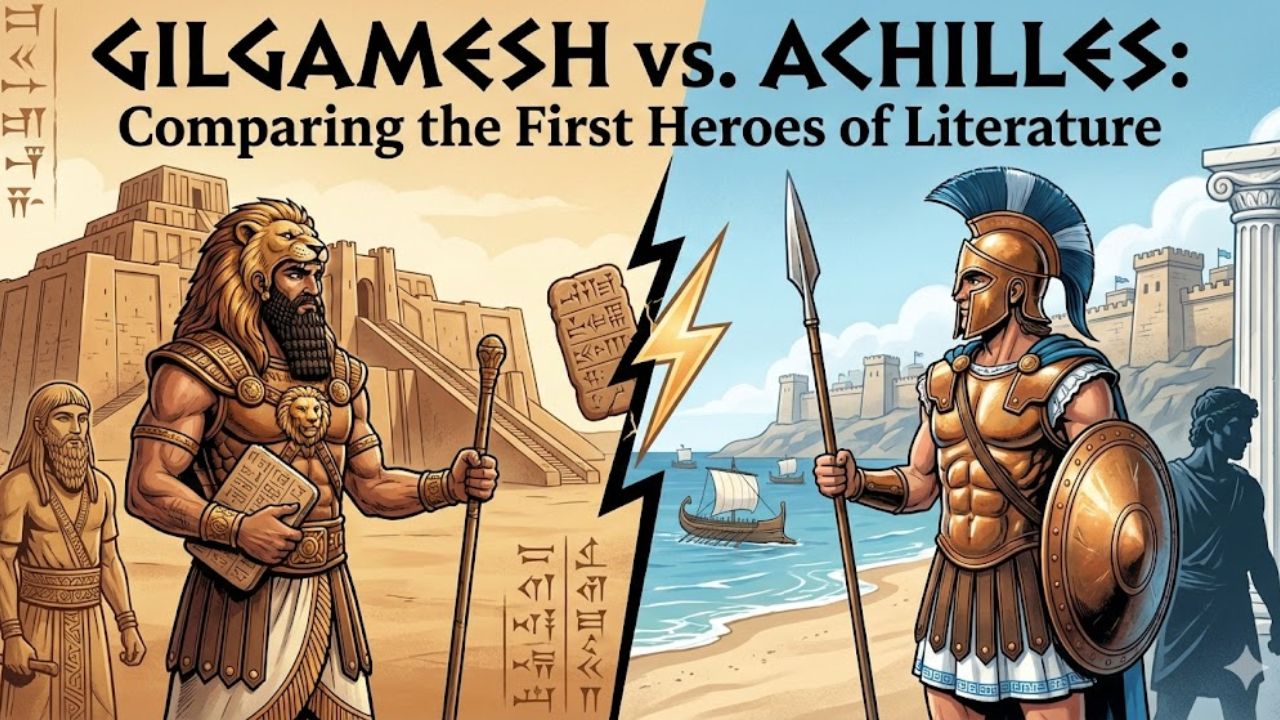
The history of Western and Near Eastern literature is anchored by two colossal figures who, though separated by over a millennium of history and the formidable geographical barriers between the Tigris-Euphrates basin and the Aegean Sea, speak to one another across the ages with a startling intimacy. Gilgamesh, the builder-king of Uruk, and Achilles, the destroyer-prince of Phthia, represent the primal archetypes of the heroic tradition. They are the “First Heroes” not merely due to the chronological primacy of their texts—the Epic of Gilgamesh and Homer’s Iliad—but because they were the first to articulate the central paradox of the human condition: the agonizing dissonance between the consciousness of eternity and the reality of biological decay.
This report provides an exhaustive comparative analysis of these two monumental figures. It posits that the Iliad is not an isolated phenomenon of Greek genius but a spiritual, and likely textual, descendant of the Mesopotamian epic tradition. Through a rigorous examination of philological parallels, narrative structures, and character arcs, this analysis demonstrates how both heroes traverse an identical trajectory: from the arrogance of semi-divine power, through the shattering trauma of loss, to a resigned acceptance of mortality.
However, while their journeys are parallel, their destinations diverge, revealing the fundamental cultural cleavage between the East and the West. Gilgamesh seeks to conquer death physically, failing in his quest for eternal life but succeeding in the creation of a civic legacy—the Walls of Uruk. Achilles seeks to conquer death symbolically, trading his life for kleos aphthiton (imperishable glory), ensuring his immortality through the medium of song. This report explores these themes through the lenses of divine lineage, the psychology of companionship, the sociology of grief, and the transmission of literary motifs during the Orientalizing Period, offering a comprehensive synthesis of how the ancient world understood what it meant to be a man, a king, and a hero.
Textual Archaeology and Historical Horizons
To understand the heroes, one must first understand the worlds that forged them. Gilgamesh and Achilles are not merely literary creations; they are the distilled ethos of their respective civilizations, crystallized through centuries of oral and written tradition.
The Stratigraphy of the Texts
The Epic of Gilgamesh is a composite text, a literary tell built up over thousands of years. The historical Gilgamesh was likely a king of Uruk during the Early Dynastic II period (c. 2700 BCE), a figure who became the subject of five independent Sumerian poems during the Third Dynasty of Ur. These disjointed narratives—tales of the “wild bull” battling the King of Kish or the monster Huwawa—were later woven into a coherent epic. The version most familiar to modern readers, the Standard Babylonian Version (SBV), was compiled by the exorcist-scribe Sîn-lēqi-unninnī around 1200 BCE. Sîn-lēqi-unninnī did not merely transcribe; he transformed. He imbued the disparate tales with a unifying theme: the quest for wisdom through suffering. He added the prologue that invites the reader to “examine the foundation” of the walls, effectively framing the entire epic as a retrospective meditation on the limits of human achievement.
In contrast, the Iliad, attributed to Homer, emerged from the dark ages of Greece, crystallizing around 750–700 BCE, though it describes events of the Mycenaean Bronze Age (c. 1200 BCE). Like Gilgamesh, it is the product of a long oral tradition, the aoidoi (singers) preserving the memory of the “glories of men” through hexameter verse. However, unlike the fixed clay tablets of the library of Ashurbanipal which preserved Sîn-lēqi-unninnī’s work, the Iliad was a fluid performance, eventually written down as the Greek alphabet stabilized.
Despite these differences in medium—clay vs. papyrus/performance—the structural similarities suggest a “genetic” relationship. Scholarship, particularly the work of Martin West and Walter Burkert, has identified the “Orientalizing Period” (c. 750–650 BCE) as a crucial window where Near Eastern motifs, including the Gilgamesh tradition, flowed into Greece via trade routes in Al-Mina, Cyprus, and Crete.6 The Iliad is not a hermetically sealed Greek invention; it is a western flowering of a shared Afro-Eurasian epic tradition.
The City vs. The Camp
The setting of each epic dictates the nature of the hero’s crisis. Gilgamesh is a hero of the City (Uruk). His story begins and ends with the walls. The city is the manifestation of order against the chaos of the wild; Gilgamesh’s initial tyranny is a failure of civic duty, and his return is a restoration of it. The “price of civilization” is a central theme; the hero must learn to be a king who serves the infrastructure of his society rather than a tyrant who consumes it.
Achilles is a hero of the Camp (the beach at Troy). He is displaced, fighting a war far from his home in Phthia. The Achaean camp is a temporary, fragile society held together by the pressure of war and the loose hierarchy of warlords. Achilles has no walls to build; he has only a reputation to maintain. His crisis is not about governance but about honor (timê) and status. In the absence of civic structures, the ego of the hero becomes the only law.
Table 1: The Chronology and Context of the Epics
| Feature | The Epic of Gilgamesh | The Iliad |
| Historical Basis | King of Uruk (c. 2700 BCE) | Mycenaean Warlord (c. 1200 BCE) |
| Composition Date | Standard Babylonian Version c. 1200 BCE | Archaic Greece c. 750–700 BCE |
| Author/Compiler | Sîn-lēqi-unninnī (Scribe/Exorcist) | Homer (Oral Tradition/Bard) |
| Primary Medium | Cuneiform Clay Tablets | Dactylic Hexameter (Oral/Papyrus) |
| Setting | The City of Uruk & The Wild | The Beach Camp at Troy |
| Cultural Value | Wisdom (Nēmequ) & Civilizing Order | Glory (Kleos) & Competitive Excellence (Arete) |
The Semidivine Condition and the Burden of the Mother
The defining characteristic of the epic hero is his liminality. He stands on the razor’s edge between the mortal and the divine, belonging fully to neither world and therefore suffering the alienation of both. This “tragic equation” of genetics is the source of both Gilgamesh’s and Achilles’ power and their existential angst.
The Mathematics of Divinity
The Epic of Gilgamesh opens with a precise, if mathematically perplexing, calculation of its hero’s nature: he is “two-thirds god and one-third man”. Born of the union between the goddess Ninsun and the mortal king Lugalbanda, Gilgamesh is designed by the gods to be perfect. The text describes him in architectural terms, noting his immense stature—eleven cubits tall and nine spans broad—a physical colossus who towers over the citizens of Uruk. This fraction—two-thirds—suggests an inherent imbalance. The divine portion gives him the appetite for eternity, the strength to wrestle giants, and the capacity to dream prophetic dreams. The mortal third, however, is the flaw in the diamond. It condemns him to fatigue, to grief, and ultimately, to the “House of Dust.” Gilgamesh is a being of infinite potential trapped in a finite vessel.
Achilles’ lineage follows a similar pattern but operates within the specific theological framework of the Greek pantheon. He is the son of Thetis, a sea goddess, and Peleus, a mortal king. Unlike Gilgamesh’s explicit fraction, Achilles’ semi-divinity is functional. He is “swift-footed” and possesses strength that terrifies ordinary men, yet he is inextricably bound to the fate of all humans. The later myths of his invulnerability (the dipping in the Styx) are not present in the Iliad; in Homer, Achilles can bleed, and he can die. His divinity is manifested in his proximity to the gods and the terrifying intensity of his emotions (his menos). He is “godlike” (theoeikelos), but the suffix -eikelos (like) emphasizes the unbridgeable gap.
The Mother-Goddess Complex
A striking similarity between the two heroes, one that strongly supports the theory of literary transmission, is the role of the divine mother. Both Gilgamesh and Achilles are “mama’s boys” in the most epic sense—constantly turning to their divine mothers for validation, intervention, and comfort.
Ninsun (The Wild Cow): Gilgamesh’s mother is Ninsun, a minor goddess associated with wisdom and cows. Throughout the epic, she acts as his intercessor. When Gilgamesh fears the journey to the Cedar Forest, Ninsun does not stop him; instead, she ascends to the roof of her temple, burns incense, and berates the sun god Shamash: “Why did you give my son Gilgamesh such a restless heart?”. She adopts Enkidu to ensure Gilgamesh has protection and interprets his terrifying dreams. She is the hero’s tether to the divine council, negotiating for his safety while he enacts his will on earth.
Thetis (The Silver-Footed): Achilles’ relationship with Thetis is even more central to the plot of the Iliad. When Agamemnon dishonors him, Achilles goes to the surf and weeps, calling for his mother. She rises from the “gray sea like a mist” to comfort him, stroking his hair and listening to his complaints. Like Ninsun, she intercedes with the supreme god (Zeus) on her son’s behalf, securing the promise that the Greeks will lose battles until Achilles is honored. However, Thetis is a tragic figure. She knows that her son’s glory comes at the cost of his life. She is constantly mourning him even while he is alive, calling him “doomed to a short life.” Thetis supplies Achilles with his armor (made by Hephaestus), literally clothing him in his divine heritage, yet she cannot armor him against his fate.
The Maladaptation to Peace
A critical insight into the psychology of both heroes is that they are fundamentally maladapted to peace. The epic hero is an instrument of violence and disruption; when there is no external enemy, he turns his energy inward, often becoming a danger to his own society.
In Uruk, Gilgamesh’s “energy” manifests as tyranny. The text explicitly states that “Gilgamesh does not leave a girl to her mother… the daughter of the warrior, the bride of the young man”. He is a destabilizing force. The creation of Enkidu is the gods’ direct response to the pleas of Uruk’s citizens, who beg for a “counterweight” to Gilgamesh. They do not ask for Gilgamesh to be removed, but for him to be occupied. The hero requires a mirror, an equal, to absorb his excess vitality so that the city can breathe.
Achilles, conversely, is introduced in the Iliad in a state of withdrawal. While Gilgamesh’s maladaptation is active (oppression), Achilles’ is passive (obstruction). When his honor (time) is slighted by Agamemnon’s seizure of the war-prize Briseis, Achilles does not overthrow Agamemnon; he unplugs himself from the war effort. He sits by the ships, playing his lyre and singing of the “glorious deeds of men”—a meta-commentary on his own desire for legend—while his countrymen die. This withdrawal is a form of “anti-heroism” that is just as destructive as Gilgamesh’s tyranny. Both heroes jeopardize the survival of their communities (Uruk and the Achaean army) because their egos cannot be reconciled with the social order.
The Other Self – Enkidu and Patroclus
The trajectory of the epic hero is never solitary. It requires a catalyst, a “second self” whose existence balances the hero and whose death shatters him. The relationships between Gilgamesh and Enkidu, and Achilles and Patroclus, are the emotional engines of their respective epics. These are not merely friendships; they are symbiotic unions where the boundaries between the two individuals blur.
The Creation of the Counterpart
Enkidu is literally created to be Gilgamesh’s match. Aruru forms him from clay, dropping him into the wild to live as an animal. He is the “natural man”—hairy, innocent, and ignorant of civilization. His journey from the steppe to the city, facilitated by the sexual initiation of Shamhat, is a microcosm of human evolution. This “civilizing” process—sex, bread, wine, and grooming—prepares him for the hero. When he finally arrives in Uruk, he physically blocks Gilgamesh’s path to the bridal chamber. Their subsequent wrestling match is the moment of recognition: Gilgamesh finds the only being in the universe who can withstand his power. In that stalemate, the tyranny ends, and the brotherhood begins.
Patroclus, by contrast, is not a magical creation but a childhood companion. Exiled from his own home for an accidental murder (a common motif for the “second” hero), he was raised in the house of Peleus alongside Achilles. While Enkidu is Gilgamesh’s physical equal (or near-equal), Patroclus is Achilles’ emotional anchor. In the Iliad, Patroclus is described as “gentle” (meilichos)—an adjective rarely applied to the bronze-clad warriors of Troy. He serves as the conscience of Achilles. While Achilles is hardened by rage and pride, Patroclus weeps for the suffering Greeks. He is the human tether that keeps the demigod grounded in empathy.
The Eros of Friendship
The nature of the bond between these pairs has generated millennia of debate. In the Epic of Gilgamesh, the language is explicitly romantic, though rooted in the metaphors of the time. Gilgamesh dreams of a meteor and an axe that he “loves like a woman” and “caresses,” which Ninsun interprets as the coming of a “strong partner” who will never forsake him. The text repeatedly emphasizes that they “kissed each other and formed a friendship.” Enkidu becomes Gilgamesh’s moral compass, curbing his worst impulses, yet he also enables his thirst for glory, accompanying him to the Cedar Forest to slay Humbaba. Their relationship is the emotional core of the story; Gilgamesh loves Enkidu more than any woman, including the goddess Ishtar, whom he spurns with disastrous consequences.
For Achilles and Patroclus, the bond is defined by a shared destiny and a hierarchy of care. Achilles dominates the relationship in terms of power, but he is emotionally dependent on Patroclus. When Achilles refuses to fight, it is Patroclus who dons Achilles’ armor—a symbolic merging of identities. Patroclus literally becomes Achilles to the world, fighting in his stead. This impersonation is the ultimate act of friendship and the seal of his doom. The Iliad suggests that while Achilles loves Briseis (the cause of the quarrel), his soul is intertwined with Patroclus. As scholars have noted, “Achilles is the body, Patroclus is the heart”. In the Greek tradition, this was often interpreted as pederastic (with Achilles as the erastes and Patroclus the eromenos, or vice versa depending on the adaptation), but Homer focuses on the philia (deep friendship) that transcends death.
The Function of the Companion
Crucially, the companion serves to “humanize” the hero before the tragedy. Enkidu teaches Gilgamesh the limits of his strength (warning him against Humbaba) and the value of mercy (though they ultimately fail to show it). Patroclus facilitates the connection between Achilles and the other Greeks, tending to the wounded Eurypylus when Achilles will not. They are the “conductors” of humanity into the lightning-rod souls of the heroes. Their deaths, therefore, are not just the loss of a friend; they are the loss of the hero’s link to his own humanity.
The Anatomy of Grief and the Lion Simile
The death of the companion is the fulcrum upon which both epics pivot. It is the moment the hero is forced to confront the absolute reality of death, not as an abstract concept to be dealt to enemies, but as a personal annihilation. The reaction of both Gilgamesh and Achilles to this loss is identical in its ferocity, providing some of the strongest evidence for the influence of the Mesopotamian tradition on Homer.
The Moment of Rupture
Enkidu’s death is slow and agonizing, a punishment from the gods for the slaying of the Bull of Heaven and Humbaba. As he withers away, he curses the agents of his civilization (the hunter, the harlot) before Shamash reminds him of the joys he experienced. Gilgamesh watches this decay, helpless. The moment of death is marked by a visceral, grotesque detail: Gilgamesh refuses to accept that Enkidu is gone until “a maggot fell from his nose”. This biological reality shatters Gilgamesh’s delusion. The King of Uruk, who sought to build eternal monuments, is undone by a worm. He realizes that the body of his friend—and by extension, his own body—is meat.
Patroclus’s death is sudden and violent, slain by Hector on the battlefield. When the news reaches Achilles, the reaction is volcanic. He pours dust over his head, defiling his “comely face,” and lets out a cry so terrible that his mother hears him from the depths of the sea. This is the beginning of Achilles’ descent into madness. He does not just grieve; he unmakes himself. The “dust” he pours on his head anticipates his own burial.
The Lion Simile: A Philological Bridge
One of the most striking parallels between the two texts—a parallel so precise it suggests direct literary transmission—is the use of the “Lion Simile” to describe the grieving hero.
In the standard Babylonian version of Gilgamesh, the hero is described circling Enkidu’s body:
“He began to rage like a lion, like a lioness deprived of her whelps… He paces back and forth before the couch…”.
In Book 18 of the Iliad, Homer uses an almost identical image for Achilles:
“…sobbing loud and often, like a great-maned lion whose cubs some deer-hunting man has stolen away from the dense forest. When it returns later, it is devastated, and it wanders many glens, seeking the tracks of the man… for an acid rage seizes it.”.
This shared imagery goes beyond coincidence. It depicts the hero not as a man, but as a dangerous animal. Grief has stripped away their humanity. Gilgamesh casts off his royal robes and dons the skin of a lion, roaming the wilderness. He literally becomes the metaphor. Achilles does not wear a lion skin, but he acts with bestial cruelty, slaughtering Trojans and sacrificing twelve noble youths on Patroclus’s pyre—an act of human sacrifice that shocks even the narrator. The “lion” represents the hero outside of society, the force of nature that has been unleashed by pain.
The Refusal to Bury
Both heroes initially refuse to bury their dead. Gilgamesh keeps Enkidu’s body for seven days and nights, hoping his weeping will bring him back, until the physical reality of decomposition forces him to stop. Achilles keeps Patroclus’s body in his tent, preserving it with ambrosia (provided by Thetis) so that it does not rot while he seeks revenge. This refusal to surrender the body to the earth is a refusal to accept the finality of death. They are in a state of suspended animation, trapping themselves and their communities in a limbo of grief.
For Gilgamesh, this grief transforms into fear. “I am afraid of death,” he confesses. “Must I too die like Enkidu?”. His mourning is selfish; he weeps for Enkidu, but he terrorizes himself. For Achilles, grief transforms into menis (cosmic rage). He does not fear death; he embraces it. He knows that killing Hector seals his own fate, and he sprints toward it. His mourning is suicidal. He stops eating, stops sleeping, and lives only to kill.
The Quest – Immortality vs. Kleos
Following the trauma of loss, both heroes embark on a quest to find meaning in a universe that has been emptied of it. Here, their paths diverge, representing the fundamental cultural differences between the Mesopotamian and Greek worldviews: the Eastern desire for Continuity vs. the Western desire for Memory.
Gilgamesh’s Quest: The Denial of Death
Gilgamesh’s journey is literal and geographical. He abandons his city and travels to the ends of the earth, seeking Utnapishtim (the Distant One), the only human granted immortality by the gods after the Great Flood. This journey takes him through the dark tunnel of Mount Mashu, a path the sun takes at night. This is a katabasis—a descent into the underworld while still alive.
Gilgamesh is looking for a “fix”—a magical solution to the biological problem of mortality. He acts like a desperate child refusing to accept the rules of the game. Along the way, he meets Siduri, the tavern keeper (and a manifestation of Ishtar/wisdom), who offers him the hedonistic/humanistic advice that has come to be known as the ancient Carpe Diem:
“Gilgamesh, where are you hurrying to? You will never find that life for which you are looking. When the gods created man they allotted to him death, but life they retained in their own keeping. As for you, Gilgamesh, fill your belly with good things… dance and be merry… make your wife happy in your embrace; for this too is the lot of man.”
This advice—to find immortality in the moment—is rejected by Gilgamesh. He is not ready to be merely human; he still wants to be a god. He pushes on to Utnapishtim, crosses the Waters of Death, and finally asks the secret.
Achilles’ Quest: The Aestheticization of Death
Achilles’ journey is psychological and static. He remains physically at Troy, but he moves spiritually toward the realm of the dead. His quest is not for eternal life (immortality of the body) but for kleos aphthiton (imperishable glory).
In Book 9 of the Iliad, Achilles articulates his famous “Two Fates” (Keres). He can return to Phthia, marry, and live a long, happy life, but his name will be forgotten. Or, he can stay at Troy, die young, and achieve a glory that will never die.
“If I hold out here and I lay siege to Troy, my journey home is gone, but my glory never dies.”
Unlike Gilgamesh, who runs away from death, Achilles runs toward it, but he demands a high price for his life. He treats his life as a currency to be exchanged for the highest possible value: eternal fame. This is the Greek answer to mortality—if the body cannot survive, the name must. However, this choice is haunting. In the Odyssey (the sequel/epilogue), the ghost of Achilles tells Odysseus that he would rather be a slave to a landless peasant on earth than king of all the dead. But in the Iliad, the choice is absolute. He chooses art over life.
The Failure and the Success
Crucially, Gilgamesh fails. Utnapishtim proves to him that he cannot even conquer sleep (the cousin of death), let alone death itself. Gilgamesh is given a consolation prize—a plant that restores youth—but he loses it to a snake while bathing. This moment is pivotal: it is the “felix culpa” (happy fall). By losing the plant, Gilgamesh is saved from the stagnant fate of Utnapishtim (who lives forever but is bored and isolated). He is forced to return to Uruk as a mortal man. The snake sheds its skin (achieving the rejuvenation Gilgamesh sought), while the man walks home empty-handed but wise.11
Achilles succeeds in his quest for kleos, but the Iliad questions the value of that success. His glory is built on the destruction of Hector, a man who represented family, duty, and civilization. Achilles achieves his “immortality,” but the poem ends with him weeping, not triumphing. He has become a monument, but he has lost his life.
Table 2: The Philosophical Divergence
| Concept | Gilgamesh (Mesopotamian) | Achilles (Greek) |
| Goal | Physical Immortality (Eternal Life) | Symbolic Immortality (Kleos / Fame) |
| Attitude to Death | Fear, Denial, Flight | Acceptance, Transaction (Life for Glory) |
| The Guide | Siduri (Advice: Enjoy Life) / Utnapishtim | Thetis (Advice: Prophecy of Doom) |
| Outcome | Failure (Loss of Plant) -> Wisdom | Success (Death of Hector) -> Tragic Grief |
| Cultural Ethos | Human life is fragile; Gods control fate. | Human life is defined by how one meets death. |
The Return to Humanity and the Architecture of Closure
The true climax of both epics is not a battle or a monster-slaying, but a moment of quiet recognition. It is the moment the hero reintegrates into the human community through empathy and the acceptance of limits.
Gilgamesh and the Walls of Uruk
After losing the plant of youth, Gilgamesh returns to Uruk with the ferryman Urshanabi. In the final lines of the epic (Tablet XI), Gilgamesh does not weep. Instead, he invites Urshanabi to climb the walls of the city:
“Go up, Urshanabi, onto the wall of Uruk and walk around. Examine its foundation, inspect its brickwork thoroughly… Did not the Seven Sages themselves lay out its plan? One league city, one league palm gardens, one league lowlands, the open area of the Ishtar Temple…”
This is Gilgamesh’s epiphany. He realizes that immortality is not found in the physical body, but in the civic body. The walls he built, the civilization he protected, and the story inscribed on the lapis lazuli tablets—this is his immortality. He transitions from a tyrant who consumed his people to a king who takes pride in the shelter he provides them. He accepts his limits. The epic ends where it began, at the walls, but the man looking at them has changed. He has accepted the “price of civilization”—that to build something lasting, one must accept one’s own transience.
Achilles and Priam: The Restoration of the Body
Achilles’ return to humanity occurs in Book 24 of the Iliad. For days, he has been dragging Hector’s body behind his chariot, trying to mutilate it, but the gods preserve the corpse. Finally, King Priam, Hector’s father, sneaks into the Greek camp to ransom the body, guided by Hermes.
Priam does the unthinkable: he kisses the hands of the man who murdered his son. He asks Achilles to “remember your own father,” Peleus, who is also an old man waiting for a son who will never return. This triggers the collapse of Achilles’ rage. For the first time, he sees a Trojan not as an object of hate, but as a mirror of his own father. The two men weep together—Priam for Hector, Achilles for Peleus and Patroclus. This “shared weeping” is the ultimate humanizing moment. Achilles cleans the body, lifts it onto the wagon, and grants a truce. He effectively rejoins the human race by recognizing the universality of suffering. He knows he will still die, and he knows he will kill more Trojans, but the menis (beastly rage) has broken.
The Iliad ends not with the death of Achilles (which is foretold but not shown), but with the funeral of Hector. This is significant. By allowing the enemy to be buried, Achilles restores the cosmic order he violated. He acknowledges that even the enemy deserves the dignity of a grave.
Literary Transmission – From Uruk to Troy?
For centuries, scholars viewed these parallels as archetypal—independent inventions of the human mind (polygenesis). However, modern scholarship, spearheaded by researchers like Martin West and Walter Burkert, strongly suggests a direct lineage.
The “Orientalizing” Connection
The Epic of Gilgamesh was the “bestseller” of the ancient Near East. Copies have been found in the Hittite capital of Hattusa and the Levant (Megiddo/Ugarit). During the “Orientalizing Period” of Greek art (c. 750–650 BCE), trade routes between the Near East and Greece were active. It is highly probable that bilingual scribes or oral poets in places like Cyprus or Al-Mina transmitted motifs from the Akkadian tradition to the Greeks. The “Orientalizing Revolution” theory posits that Greek literature was deeply indebted to Semitic and Anatolian precursors.
Specific Parallels
Beyond the broad strokes, the specific details argue for transmission:
- The Lion Simile: As discussed, the linguistic similarity in the description of the grieving hero is uncanny.
- The Divine Mother Intercession: Ninsun asks Shamash to help Gilgamesh; Thetis asks Zeus to help Achilles. The structure of the scenes is nearly identical.
- The Refusal to Bury: The specific motif of keeping the body until a sign of decay (Gilgamesh) or divine intervention (Achilles) appears.
- The Wanderings: While Achilles does not wander geographically in the Iliad, his “wandering of the mind” and social exile mirror Gilgamesh’s trek.
- The Wrath (Menis): The very theme of the Iliad—the wrath of the hero causing devastation to his own people—mirrors the opening of Gilgamesh, where the hero’s energy devastates Uruk.
These links suggest that the Iliad is, in some respects, a “Greek retelling” of the Gilgamesh mythos, adapted to a culture that valued competition (agon) and glory over the Mesopotamian values of wisdom and resignation.
Conclusion: The Walls and the Song
Gilgamesh and Achilles remain the twin poles of the Western literary imagination because they answer the question of death in the two ways that still dominate human thought: Legacy and Art.
Gilgamesh represents the Monumental. He finds solace in the tangible—the walls of Uruk, the tablet box, the city. His heroism concludes with the construction of civilization. He teaches us that because we die, we must build. His immortality is civic and collective.
Achilles represents the Memorial. He finds solace in the intangible—the song, the glory, the memory in the minds of others. His heroism concludes with the construction of a narrative. He teaches us that because we die, we must live with such intensity that the world cannot forget us. His immortality is individual and aesthetic.
Ultimately, both heroes undergo a “humanizing” process that strips them of their divine pretensions. Gilgamesh learns he is not a god; Achilles learns he is not a beast. They end their stories as men—grieving, mortal, but painfully, beautifully alive. In the final analysis, their victory is not over their enemies, but over their own despair. They look into the abyss of the grave and, instead of flinching, they create meaning. Gilgamesh points to the brick; Achilles points to the poem. And five thousand years later, we are still looking at both.
Key Comparisons Summary
| Theme | Epic of Gilgamesh | The Iliad |
| Primary Bond | Gilgamesh & Enkidu | Achilles & Patroclus |
| Reaction to Loss | Fear of own death; Roaming the wild; Rejection of culture. | Rage at the killer; Mutilation of the dead; Rejection of life’s needs. |
| The “Fix” | The Plant of Heartbeat (Restored Youth). | Kleos (Eternal Glory in Song). |
| Humanizing Moment | Seeing the worm fall from Enkidu’s nose; Viewing the Walls of Uruk. | Weeping with Priam; Returning Hector’s body. |
| Legacy Symbol | The Wall (Material Culture). | The Song (Oral Culture). |
| Closing Image | The King surveying his city. | The funeral of the enemy (Hector). |